Thursday, September 30, 2010

Turning Public Servants into Service Partners | ResPublica

Turning Public Servants into Service Partners | ResPublica

Devaid Erdall puts forward the case - and the steps needed - for turning public service providers in the UK into worker-cooperatives or employee-owned businesses.

I agree with the tone and general direction of this proposal and believe this represents a genuine alternative to slashing public services or maintaining them at a time of unsustainable levels of public debt.


Wednesday, September 29, 2010

Eller on Sects


Vernard Eller's theoretical introduction to the concept of Orthodox Protestant sects - which overlap considerably with the Third Stream groups described in this blog - is a helpful article for thinking about the differing aspects of the subject.

Eller - who died in 2007 and was a member of the Church of the Brethren - attempts to fuse the sociological insights on sectarianism of Ernst Troeltsch with the theological paradigm of Emil Brunner.

Eller's work is contained within chapter three of his Kierkegaard and Radical Discipleship, here and includes his spectrum chart (left) of different understandngs of a sect.

Recommended reading.
Enhanced by Zemanta

On Reformation Sects

German Anabaptist Adam Pastor (16th century); ...Image via Wikipedia
"[Anabaptist sectarianism] attacked the new theological dogmatism, the compulsory State Church, and the tendency to secularization [of the Reformation "churches"]....

The Anabaptists deliberately opposed the results of this compromise, and in so doing they opposed the whole idea of the Church, and of an ecclesiastical civilization.

This violent opposition, however, proves that in reality it had been caused by the Reformation itself...."


Soren Kierkegaard


Enhanced by Zemanta

Peak Oil Entering Political Mainstage

Both the British government (here) and the German military (here) are reported this week to be actively planning towards the possibility of a global spike in the price of oil as the amount of gas and oil continues to decline, and despite environmentally unsustainable exploration in deep oceans and the Arctic.


If you enjoyed this post, get free updates by email or RSS.
Enhanced by Zemanta

Tuesday, September 28, 2010

UN Fact-Finding Mission Says Israelis "Executed" US Citizen Furkan Dogan

Seal of the United States Department of State.Image via Wikipedia
t r u t h o u t | UN Fact-Finding Mission Says Israelis "Executed" US Citizen Furkan Dogan

Far be it from me to wade into an analysis of the Israeli-Palestine issue - which, to quote President Obama, would be "above my pay grade" - but.....

The official UN report on the human rights aspect of the boarding of the flotilla to Gaza by Israeli commandos in May of this year has been published. In fact, it was published in July. No, I hadn't heard anything about it either.

Which is surprising, because an American citizen, Furkan Dogan was among those killed during the raid. The UN report on his death makes uncomfortable reading, describing his death as an "execution".

Gogan was shot twice in the head, once in the back and in the left leg and foot before being shot in the face at point blank range while lying on the ground. Based on the "forensic and firearm evidence," the UN panel concluded that Dogan's killing and that of five Turkish citizens, "can be characterized as extra-legal, arbitrary and summary executions."

My point in relating this unpleasant story is to highlight the way that, when pursuing their foreign policy objectives, elected governments such as that of the United States will often make use of the death of their citizens overseas as a way of justifying aggressive actions against the offending states.

On this occasion, however, the US administration is pursuing a policy of not commenting on the incident. In a written statement, which appears to have been dragged out of a reluctant State Department by Truthout magazine, we read:


"We urge that this report not be used for actions that could disrupt direct negotiations between Israel and Palestine that are now underway or actions that would make it not possible for Israel and Turkey to move beyond the recent strains in their traditional strong relationship."


There we have it then. And not a hint of the story being reported on the main US media channels.


If you enjoyed this post, get free updates by email or RSS.

Saturday, September 25, 2010

Cyber attack 'targeted Iran' - Middle East - Al Jazeera English

A political and geographical map showing count...Image via Wikipedia
Cyber attack 'targeted Iran' - Middle East - Al Jazeera English

I don't recall reading this story in the western press, but Kaspersky Labs, no less (who provide the security systems for Barclays Bank customers) have described the recent Stuxnet trojan (which has infected machines around the world, but particularly in Iran) as "a working and fearsome prototype of a cyber-weapon....Stuxnet manifests the beginning of the new age of cyber-warfare."

The company's official news site goes on to say, "We believe this type of attack could only be conducted with nation-state support and backing."

"It's pretty clear that based on the infection behaviour that installations in Iran are being targeted," says Kevin Hogan, the senior director of Security Response at Symantec, according to Reuters.

So, a cyber attack against Iranian energy installations. Conducted with nation-state backing.

Who could be behind that, I wonder?


If you enjoyed this post, get free updates by email or RSS.
Enhanced by Zemanta

Friday, September 24, 2010

FBI Launching Mass Raids of Antiwar Activists’ Homes -- News from Antiwar.com

180 pxImage via Wikipedia
FBI Launching Mass Raids of Antiwar Activists’ Homes -- News from Antiwar.com


They came first for the Communists,
and I didn't speak up because I wasn't a Communist.

Then they came for the trade unionists,
and I didn't speak up because I wasn't a trade unionist.

Then they came for the Jews,
and I didn't speak up because I wasn't a Jew.

Then they came for me
and by that time no one was left to speak up.


Pastor Martin Niemoller, German anti-Nazi theologian (1892–1984)


If you enjoyed this post, get free updates by email or RSS.
Enhanced by Zemanta

Thursday, September 23, 2010

Suffolk County Council to Outsource Most Services

BBC News - Suffolk County Council to outsource most services


I've written elsewhere about post-democracy - the term coined by Professor Colin Crouch to describe the decline of mass participatory democracy in the latter part of the twentieth century and since.

One of the features of post-democracy, according to Crouch, is the tendency for governments to increasingly act as corporations.

The decision of Suffolk County Council, therefore, to outsource virtually all of its public services - cutting its budget by about 30% in the process - is a logical though dramatic example of this trend.


Tuesday, September 21, 2010

Tea Party Congressional Candidates: a Gift to the Democrats

The surprising victories of a number of Tea Party candidates in recent US primaries for November's Congressional elections must have the Democratic Party hierarchy laughing.

The Republican right must be ruing the day they tacitly encouraged this "grass roots" movement to gather momentum. Having initially focused their anger at President Obama's health care reforms, the conservative movement has now turned its guns on members of the Republican establishment in a number of key marginal seats.

The result is the selection of such luminaries as Christine O'Donnell as Republican Party candidate for the Senate race, from the state of Delaware. She has already lost one Senatorial race in the state in 2008, is widely regarded as unelectable at Congressional level and is currently trailing in opinion polls behind the Democratic candidate Chris Coons.

Columnist Elizabeth Scalia, who is not entirely unsympathetic to O'Donnell as an individual, admits that Delaware's rising star is:


"Palin-Lite; half the experience, less bitter. In her favor, though, is that she appears to be utterly without guile."


It is key battlegrounds such as Delaware that the Republicans must win in November if they are to gain a majority in either House in Congress and thus further restrict Obama's policy ambitions.

The Tea Party's claims to be a grass roots movement have been significantly exposed by a recent article in the New Yorker magazine, which traces significant amounts of funding from the movement back to foundations controlled by the billionaire Koch brothers, who, according to Jane Mayer of the New Yorker

"are longtime libertarians who believe in drastically lower personal and corporate taxes, minimal social services for the needy, and much less oversight of industry—especially environmental regulation."


If recent results are anything to go by, it appears that the Republican Party may have created a monstor which is now turning on its creator. Which will have the Democrats smiling, I would imagine.


If you enjoyed this post, get free updates by email or RSS.

Monday, September 20, 2010

Saturday, September 18, 2010

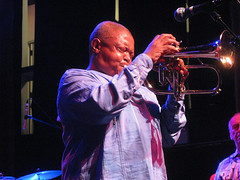
Hugh Masekela BBC4

Hugh Masekela (1)Image by H.L.I.T. via Flickr
Enjoyed last night's Welcome to South Africa, profiling Jazz trumpeter and singer Hugh Masekela.

Having seen the silver-trumpeted one live a couple of times, I was both mesmerized by some of the songs featured, and a little unsure about the choice of the predominately white British choir accompanying him at the Barbican, where he played his 70th Birthday concert last December.

Only when I spotted choir-master Gareth Malone on stage for the final song did I put the pieces together and, with a bit of help from google, figure out that the choir was the London Symphony Orchestra's St Luke's Community Choir and that the concert featured on the programme was probably the last performance of the choir with Malone as musical director.

To me, the performances lacked something of the rawness and energy of Masekela's younger days, but the fusion of the orchestra, choir, jazz, mbaqanga, Hugh's gravelly voice and his silky smooth trumpet playing did, without a doubt, create a beautiful sound.

If you missed the programme, it's on iPlayer right here (but only for seven days, you know how it goes).


If you enjoyed this post, get free updates by email or RSS.
Enhanced by Zemanta

Friday, September 17, 2010

Martin Luther Rap

In the week that the Pope visits the UK, a new take on an old dispute.

Any artist who can incorporate the phrase "hypostatic union" into a rap song is worth a listen, in my opinion.


95 Theses Rap from 8BIT Network on Vimeo.


Sunday, September 12, 2010

How Inception Should Have Ended


If you enjoyed this post, get free updates by email or RSS.

Food Riots, Deaths in Mozambique

"Thirteen people were killed and hundreds wounded last week in Mozambique when police cracked down on a three-day protest over a 30 percent hike in the price of bread. The UN says the riots in Mozambique should be a wake-up call for governments that have ignored food security problems since the global food crisis of 2008, when countries around the world saw angry protests in the streets over the rising prices of basic food items."

Pulse


If you enjoyed this post, get free updates by email or RSS.
Enhanced by Zemanta

Wednesday, September 08, 2010

The Psychological Cost of New Zealand's Earthquake

Was interested to read a comment by an old friend who lives in Christchurch, NZ, and is living through the aftermath of the country's worst earthquake in living memory.

Ken Shelley is a church pastor and notes on his blog that the New Zealand Government has today allocated NZ$ 2.4 million for counselling services for those affected by Saturday's quake, which measured 7.0.

Although there were no deaths as a result of the quake, the population of Christchurch is suffering from widespread damage to its infrastructure. The BBC reports that 100,000 of the city's homes (about two-thirds of the total) have been damaged in some way. Residents are unable to flush toilets because of damaged sewers and all drinking water has to be boiled. A state of emergency and nighttime curfew have been extended by a week. Shelley notes that the strong aftershocks are a source of particular distress to city residents:
The situation is unnerving. The big quake on Saturday was bad enough but the ongoing aftershocks are very unsettling. In the last twelve hours there have been 14 shakes of magnitudes from 2.5 to 5.1. Each time the ground starts to shift and the house rattles adrenaline pumps through your body, your heart races and you brace yourself ready to run for cover… only for the moment to pass and you force yourself to calm down. Parents with children are particularly vulnerable to anxiety – well you would be.
Later on, he states:
I have to admit it. I’m rattled. I’m a bit snappy. Perhaps I could help the government spend $2.4 million.

A major aftershock on Wednesday (the biggest so far) apparently reduced some rescue workers to tears, according to reports from the BBC.


The psychological cost of earthquakes is often under-reported. If the government in New Zealand sees the need to invest in counselling services for such an event, it is difficult to imagine the effect on the psyche of a nation which suffers large loss of life through an earthquake.


If you enjoyed this post, get free updates by email or RSS.
Enhanced by Zemanta

Sunday, September 05, 2010

Lessons from Afghanistan

Robert BlackwillImage via Wikipedia
Robert Blackwill, is a former U.S. Ambassador to India and was a member of the National Security Council during the Bush administration (with responsibility for Iraq). In a recent speech, Blackwill noted the following lessons that future policy makers should learn from America's Afghanistan experience:

  • Keep U.S. policy objectives feasible. No dreams allowed.
  • Take into account that local realities dominate global constructs.
  • Stay out of long ground wars in general, and especially stay out of long ground wars in Asia.
  • Reject the notion that America has the capability to socially engineer far-off societies fundamentally different from our own.
  • Be cautious about making counterinsurgency the U.S. Army's core competence. Interacting with exotic foreign cultures on the ground, not to say dramatically changing them, is not exactly America's comparative advantage.
  • Accept that diplomacy is almost always a better instrument of U.S. national purpose than the use of military force.
  • Remember that often purported worst case consequences of U.S. external behavior don't ever happen, not least because we remain the most powerful and resilient country on earth.

Also from Stephen M Walt, who is the source of the above summary of Robert Blackwill's speech, is a great piece on 10 Reasons Wars Last Too Long. One of the many insightful quotes from the essay is:

Great powers often stay in losing wars not because the stakes in a particular conflict are so large, but because they fear that withdrawal will have profound effects on their reputation and far-reaching repercussions elsewhere. The scholarly literature on this issue suggests that these concerns are usually exaggerated, but that doesn't stop pundits from making this claim and doesn't stop politicians from listening to it.


A further lesson (my own I suppose) is to recognise that the perceived dangers of backing out of an un-winnable war (in terms of loss of national prestige) are far greater than those associated with staying in one.


Source of Blackwill quote is from Stephen M Walt.


If you enjoyed this post, get free updates by email or RSS.

Craigslist, Trafficking and the Contradictions of Secular Liberalism

Although the decision by Craigslist to remove its "adult services" section in the US is a small step in the right direction, the move highlights the inherent contradictions at the heart of a secular and liberal worldview.

On the one hand, advocates of a permissive Craigslist cite a perceived right to personal freedoms in relations between consenting adults as a reason to resist calls for such services to be removed. The site, after all, is routinely described as embodying the true spirit of the (uncensored) Internet.

At the same, such advocates must surely recognise the human misery caused by "adult" and erotic services, in which women and children are trapped through drug addictions, or are forcibly trafficked into a system described by the UN as a modern form of slavery. It's 2008 report on the subject estimated that worldwide, 2.5 million people had been trafficked for a variety of purposes, including sexual exploitation.

Therein lies the dilemma for the secular liberal. One man's freedom becomes another (woman's) sexual exploitation. And secular liberalism does not seem capable of addressing, much less resolving, this inherent contradiction.


If you enjoyed this post, get free updates by email or RSS.

Thursday, September 02, 2010

Give Me That Old Time Sectarian Religion

Sketch of Søren Kierkegaard. Based on a sketch...Image via Wikipedia


Whatever of true Christianity is to be found in the course of the centuries must be found
in the sects and their like.


Søren Kierkegaard


Enhanced by Zemanta