Showing posts with label Russia. Show all posts

Saturday, October 06, 2012

Turkey-Syria Boarder Clash: a NATO issue?

Clashes in recent days between Syrian and Turkish ground troops in the boarder region near the Turkish village of Guvecci have the potential to turn an internal Syrian conflict into a regional nightmare. 

Journalist Ashin Ratanshi appears to be suggesting in this interview with Russia Today that he thinks the US may be involved behind the scenes, urging Turkey to take military action against the Assad regime.

Today's decision by the Turkish Parliament to authorise action for a period of one year followed the landing of a single shell some 50 meters on the Turkish side of the boarder. It landed some distance from the village, and resulted in no injuries. 

As a NATO member, Turkey will be aware of the treaty doctrine that "an attack on a single member is considered an attack on them all." Interpreted literally, the recent skirmishes could provide some legal justification for US-supported action against Syria.


If you enjoyed this post, get free updates by email or RSS.

Friday, February 03, 2012

Chris Huhne and the Rule of Law

English: Chris Huhne at the Liberal Democrat S...Image via Wikipedia


Chris Huhne's resignation today highlights an important fact about British political life that is not always apparent to those of us living within it day in and day out. The law of the land is regarded as paramount, and politicians who breach it or, as in the case of the Energy Secretary, are charged with doing so, are expected to be held to account, regardless of their wealth or status.

This may seem obvious, but it worth reflecting on the fact that this principle - that no-one is above the law - is not universally recognised around the world. The BBC's current series on Putin illustrates that in Russia as in many other countries, politicians can and do literally get away with murder. Indeed, in Medieval Britain, the assumption that the rich should be excluded from harsh treatment under the law was elevated almost to a moral principle. The idea that kings and nobles could be brought to court along with commoners was a hard-fought-for concept. 

I for one am grateful that such a principle won the day, and that we continue to live in a country where it is expected that politicians are not above the law.


If you enjoyed this post, get free updates by email or RSS.
Enhanced by Zemanta

Wednesday, August 24, 2011

John Hutton, Russian Gas, Georgia and Wiikileaks

Emblem of Federal Security Service of the Russ...Image via Wikipedia


Confidential US State Department cable 08LONDON2384 , published by Wikileaks, contains the following quote relating to the Russian invasion of Georgia's Abkhazia region in August 2008. 

At a meeting in September 2008 between US Deputy Secretary of Energy Jeffery Kupfer and the then British Business Secretary John Hutton, discussion turned to Russia's growing dominance of the European gas market. The discussion is summarised as follows:


Hutton stated that the EU is never going to speak with one voice on

energy security, pointing out that each country has dealt with supply

issues independently. He pointed to the growing European dependence on

Russian gas, and the fact that much of Gazprom's board was former

Federal Security Service (FSB). These factors, Hutton said,

contributed to the EU's feeble response to the Russian invasion of Georgia.


If you enjoyed this post, get free updates by email or RSS.
Enhanced by Zemanta

Friday, December 03, 2010

Fifa and the World Cup Bid: a Proposal

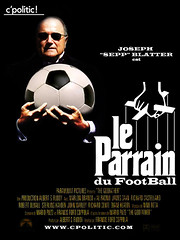
Sepp Blatter: Le Parrain du FootballImage by blogcpolitic via Flickr
As an Englishman and a football fan, I find myself not terribly disappointed that we lost the bid for the 2018 world cup. I know that millions are.

For me, I long ago lost confidence in Fifa, which I see as a corrupt and unaccountable organisation, wedded to global capitalism and rife with cronyism. I find Sepp Blatter an unpleasant man with dictatorial tendencies and, frankly, I think the game of football is better served the less he is involved with it. A Fifa tournament taking place in the mafia state of Russia seems tragically appropriate.

Nonetheless, I do see an alternative.

We're not terribly good at this sort of thing in England, with our strong instincts to appear as the nice guys, but would the interests of the game be served if we withdrew from Fifa and put on our own world tournament - at a time and place of our choosing?

Mr Blatter would rant and rage and threaten unimaginable consequences over such a move but, in reality, would be powerless to stop it. This is the man who this week described Britain's free media as "evil" following the Panorama broadcast alleging corruption within Fifa.

There is a difference between football the sport and Fifa the organisation. They can be separated. Those of us who enjoy the game do not belong to Fifa. Sepp Blater has no authority over us. He doesn't own the sport - just the contracts with Emirates, Visa and Coca Cola.

We're free to do what we like with the beautiful game. The men in suits can get stuffed.


If you enjoyed this post, get free updates by email or RSS.
Enhanced by Zemanta

Wednesday, November 17, 2010

Is Medvedev About To Redraw Russia's Map? - Radio Free Europe / Radio Liberty © 2010

RFE/RL broadcast regions as of March 2009Image via Wikipedia
Is Medvedev About To Redraw Russia's Map? - Radio Free Europe / Radio Liberty © 2010

Interesting piece from Radio Free Europe ( a US government-funded media outlet, note) on whether President Medvedev is about to undertake large scale internal geographical and administrative reforms within Russia, creating around 20 super-regions centred on large cities.

There are currently 83 territories, regions and other districts in Russia at present.

We'll find out on November 22 when the President makes his annual state of the nation address.


If you enjoyed this post, get free updates by email or RSS.
Enhanced by Zemanta

Monday, April 12, 2010

Harry's Place » RIP Anna Walentynowicz

Harry's Place » RIP Anna Walentynowicz:

"Among those killed in Saturday’s terrible plane crash was 80-year-old Anna Walentynowicz, the former crane operator and trade union activist whose firing in 1980 from the Lenin Shipyards in Gdansk helped spark the Solidarity movement which eventually toppled Poland’s Communist government."


If you enjoyed this post, get free updates by email or RSS.

Saturday, May 31, 2008

Kosovo - Not Yet a Done Deal


News that the EU has delayed its planned police mission to Kosovo suggests that rocky times lie ahead for Europe's newest country.

Once the mandate for the UN mission in Kosoko (UNMIK) ended in mid-June, the EU was due to take responsibility for providing a police service to help stabilise the republic during its transition to independence.

Having threatened to use its veto in the UN to stop the EU initiative, Russia has effectively blocked the establishment of the EU police force in Kosovo. The result will be months of uncertainty, during which Serbia, from whom Kosovo succeeded in February of this year, will continue to attempt to derail the emergence of a fully-fledged Kosovon state. Russia backs Serbia in its rejection of Kosovon independence.

Meanwhile, Serbia continues to try and consolidate its position over districts in northern Kosovo (which boarder Serbia and have Serb majorities.) Leposavic, Zvecan and Zubin Potok have had little input from UNMIK and, in the absence of a Kosovon or European police force, are vulnerable to Serbian annexation, a move which the US says they "absolutely oppose."

The Kosovon government, meanwhile, has come under criticism for its failure to secure sufficient recognition by other nations to be granted a place at the UN general Assembly. 97 is the number of endorsements required. So far, less than 50 countries have formerly recognised the Republic of Kosovo. Recent countries to do so include Sierra Leone and Liberia.


If you enjoyed this post, get free updates by email or RSS.
Friday, May 30, 2008

111 Countries Agree Cluster Bomb Ban

The Dublin Conference on Cluster Munitions has concluded with a landmark international agreement banning the production, transfer, stockpiling and use of cluster munitions, as well as providing help for the victims of such weapons and committing signatories to the clearing of areas previously bombed within 10 years. The agreement requires the destruction of existing stockpiles within 8 years.

UN Secretary-General Ban Ki-moon welcomed the new agreement as "a new international standard that will enhance the protection of civilians, strengthen human rights and improve prospects for development."

The agreement is the culmination of a process of negotiation that began with the Oslo Process of February 2007 and was furthered at the Wellington Conference in February 2007. The agreement has been signed despite the absence of many major producers of cluster bombs - the United States, China, Russia, Israel, India and Pakistan.

Irish Foreign Minister Michael Martin, hosting the conference, expressed the hope that the new agreement will "stigmatise" the use of cluster weapons in any further conflict, even on the part of non-signatories. A similar pattern followed the banning of land mines, which the United States initially refused to sign up to.

The decision of the British government to drop its previous objections to the agreement represented a significant moment of breakthrough in the conference - although it was obtained as a result of a vague compromise clause which allows for the possible development of future more precise weapons in the future.

Steve Goose, from Human Rights Watch, expressed the belief that as a result of the historic agreement, "Cluster munitions have been tossed on the ash heap of history." The video below provides some background to today's treaty.

Further posts on this blog on the subject of cluster munitions can be viewed here and here.


If you enjoyed this post, get free updates by email or RSS.

Thursday, March 27, 2008

Space Junk Threatens Privvy


A Russian farmer is suing the country's space agency for compensation after he claimed a 10-foot-long chunk of metal from a space rocket fell into his yard, just missing his outdoor toilet.

Boris Urmatov, who is visually handicapped, lives in the village of Kyrlyk with his sister Marina. The village lies under the flight path of rockets launched from the nearby Baikonur space centre and is, according to locals, frequently the location of near-misses from assorted space junk falling from the sky.

Mr Urmatov, a sheep herder, is suing the agency for 1 million rubles (£21,000) after what he describes as "an enormous metal casing" woke him in the night as it landed adjacent to his home: "It nearly crushed the outhouse," claims his sister.

Mr Urmatov is seeking damages for stress suffered as a result of the incident.

Russian paper Izvestia (News) says that the Mr Urmatov has legal precedence for his claim. In 2001, the Russian space agency Roskosmos paid compensation of 10,000 rubles (£212) to a private individual when a piece of space junk fell on his yard as he was outside chopping wood.

For archive (though not very interesting) film of a Russian satellite taking off, please click here.

Source: Reuters


If you enjoyed this post, get free updates by email or RSS.

Friday, February 29, 2008

Eurovision Buries its Head in the Balkan Sand


I was worried sick.

What with all the burning of EU flags and rioting in the streets of Belgrade, I feared the worst.

With the Eurovision Song Contest only three months away, there seemed every prospect that recent political upheavals in Kosovo might jeopardize the contest, to be held in the Serbian capital on May 24th.

Thankfully, the organisers have reassured Europe's music-loving masses that, independence or not, the show must go on - in Belgrade.

The official statement from the European Broadcasting Union acknowledges that it has of course been following the recent development [sic] in Serbia but has concluded that the recent irregularities in Belgrade will not cause any delays in the event in May." Hurray!! I'd hate any irregularities - the formation of a new state or the subsequent rioting of its disaffected ethnic minority - to delay the fun.

Furthermore, we are assured, the EBU has no plans to move the 53rd contest from Belgrade and will, furthermore, obtain a security guarantee from the government of Serbia regarding a complete and absolute safety [sic] of all participants and visitors.

Phew! So no duffing up the Albanian entrant, then?

Certainly not, continues the EBU, who are giving its full support to the [host broadcaster] RTS in producing a successful Eurovision Song Contest in May.

Well, at least that's clear. I can book my flights and accommodation with a clear mind now. And I suppose that if the Serbian government can't provide "a security guarantee" for their own citizens in Kosovo, the next best thing is to provide one for the visiting musicians, singers and media types from Belgium, Latvia and Portugal.

I do wonder, however, how the Former Republic of Yugoslavia's well-rehearsed block voting will work this time and what new artistic alliances will be formed under the spotlights of the vast Belgrade Arena? Stronger-than-average antagonism towards Britain's entry on the part of Bulgaria, Serbia and Russia, methinks.


If you enjoyed this post, get free updates by email or RSS.

Thursday, February 21, 2008

Oil Found in Albania, Close to Kosovo


You couldn't have made it up.

On January 10, 5 weeks before the Kosovan Parliament made its unilateral declaration of independence from Serbia - the Swiss-based Manas Petroleum Corporation
broke the news. A survey of the company's exploratory fields in northern Albania had identified "large prospects" of oil and gas, close to the boarder with Kosovo.

Estimates of the find are up to 2.98 billion barrels of oil and 3.01 trillion cubic feet of natural gas, a find that Manus describes as "giant" in its official press release.

None of which, of course, had anything whatsoever to do with the enthusiastic American and British support for the new Republic of Kosovo located 50 km from the oil fields - a course of action that has set these countries on a collision course with Serbia and Russia and which has divided the European Union.

Who was it who said that
America is addicted to oil?

Credit to Stephen Lendman at Indy Media for unearthing this story.


If you enjoyed this post, get free updates by email or RSS.

Monday, February 18, 2008

Guess Who is Opposing Ban on Cluster Bombs?


With delegates from more than 120 national governments meeting in New Zealand to discuss a world ban on the use of cluster bombs, Britain, the US, China and Russia are all opposing the idea. The latter three are not even attending.

New Zealand Defense Minister Phil Goff opened the 5-day conference by informing delegates that its aim was "to build agreement among a sufficient mass of countries, including those who possess cluster munitions, to form a legally binding treaty to stop unacceptable harm to civilians."

Figures for the percentage of mini-bomblets contained within a typical cluster bomb that fail to detonate on impact are, not surprisingly, heavily disputed. While the MOD figure is 6%, Landmine Action places the total between 7-11%, based on the failure rate of cluster bomblets in the Kosovo campaign of 1999.

With some types of cluster bomb containing bomblets (technically sub-munitions) that are brightly coloured, they are about the size of a soft drink can and have proven a particular danger to children.

Unicef estimates that about 1000 children in Iraq have been injured or killed by such munitions since the 2003 war, the sub-munitions remaining live for months or years after their initial deployment. After the first Gulf War, there were over 1,600 deaths or injuries to Kuwaiti citizens from unexploded cluster bomblets used in that country to drive out Iraqi forces.


The following table indicates the number of cluster bombs used in Iraq by American and British forces since 2003. Figures are in the public domain and are from the British Ministery of Defence and the US Pentagon.

Type

Quantity

Number of bomblets (sub-munitions)

Originator

Location

RBL 755 (arial delivery)

66

147 per bomb (=9702)

RAF

Not stated

L20 Cluster Shells

2,098

49 per shell (=102, 802)

Royal Artillery

Basra

CBU-103

818

202 per missile (=165,236)

USAF

Not stated

BBU-105

88

202 per missile (=17776)

USAF

Not stated

CBU-105

6

202 per missile (=1212)

USAF

Baghdad


China, Russia and the United States - the main producers of cluster bombs - are not participating in the Wellington Conference either directly or by sending observers. Meanwhile, France, Germany, Japan and the UK have been tabling motions to restrict the terms of any agreement reached at the conference - including excluding certain weapons from a ban, allowing their use in conflicts with countries which do not sign the treaty and building in a transition period before any ban becomes law.


Steve Goose of Human Rights Watch responded: "The treaty must not be weakened to pander to the interests of users, producers and stockpilers."


If you enjoyed this post, get free updates by email or RSS.

Sunday, February 17, 2008

Kosovo - is the Cold War Really Over?

With a declaration of independence expected today in Kosovo, it is worth noting how the emergence of the new state is serving the purpose of strengthening American and British interests in the region at the expense of Russia, who are strongly backing Serbia's opposition to any such unilateral declaration.

In one sense, this last twist in the tale of the dismantling of the Former Republic of Yugoslavia is evidence of the growing antagonism between Russia and "the West". Relations have turned sour over a range of issues:
  • the creation of a US missile defense shield in eastern Europe - an act which Moscow has described as "provocative"
  • the increase in Presidential power at the expense of the Russian Parliament and the corresponding reduction in democratic checks and balances on the President
  • numerous instances of press intimidation inside Russia including the murder of several investigative journalists
  • the Litvenenko affair - British authorities seeking the extradition of a former KGB agent to stand trial for the murder of a Russian exile in London
  • tensions over gas and oil supplies from Russia to the west
  • Western support for anti-Russian political movements in the former Soviet Union - most notably in Ukraine and Georgia
  • Alleged incursions of Russian military planes into NATO air space in recent months
Seen against this backdrop, Western support for the new state of Kosovo is a convenient way of supporting democracy while also dealing a blow to Russian influence in the Balkans. The PR value of America and Britain supporting a Muslim-majority democracy will also not have been lost on policy makers in London and Washington.


If you enjoyed this post, get free updates by email or RSS.

Wednesday, February 06, 2008

Chomsky: Pakistan is a Failed State

I can't remember the last time I blogged twice about Noam Chomsky in the same week.

Here, in an interview with Aaj Television, Chomsky expresses his view that Pakistan is in danger of social and political collapse.

The evidence:
  • a rebellion in Baluchistan
  • lack of control in the FATA region
  • unrest in Sindh Province following the assassination of Benazir Bhutto
  • mounting political violence in urban areas
A range of factors have contributed to this situation, says Chomsky, including American support for the country's military rulers over decades, initially as a barrier against Russian influence and more recently as an ally in the War on Terror. The result of this support has been heavy militarization, the ignoring of Pakistan's' nuclear programme and the undermining of institutions for encouraging democratic participation and decision making.


If you enjoyed this post, get free updates by email or RSS.

Saturday, January 26, 2008

Asteroid is Hurtling Towards Earth


For reasons that will have conspiracy theorists twitching nervously, the world's mainstream media has been strangely silent about the impending near-arrival of a giant asteroid which is due to pass within 334,000 miles of earth on January 29th.


The asteroid - labelled 2007WD5 by Nasa's Near-Earth Object Programme - looks set to pass close enough to be visible by amateur astronomers and has been described as "potato-shaped" measuring 150-500 metres in length.

An impact of an object this size, travelling at 30,000 miles per hour, would be devastating were it to hit the earth, a prospect which NASA are not predicting, but perhaps not loudly enough to calm the nerves of the web's more nervous observers.

Students of near earth events will be familiar with the Tunguska Event when, on June 30th 1908, a meteoroid (it is now assumed) exploded about three miles above the Siberian forest north west of Lake Baikal causing widespread devastation over an area of approximately 800 square miles. A similar event above a major city of the time would have had a major effect on the course of 20th century history.

The colourful interactive space map on NASA's site shows what close means in cosmic terms as you follow the path of the asteroid around the inner solar system. Not one for those of a nervous disposition.


If you enjoyed this post, get free updates by email or RSS.

Sunday, January 06, 2008

Russians Saved After Three Months


This is a wonderful story. I love the fact that despite eleven fishermen being lost (count them), no-one, apparently, made much of an effort to rescue them. The crew repaid this devotion by avoiding all contact with the outside world for three months - until their food ran out.
The fact is they were about 60 miles from the regional capital - and there were other settlements between them and the city.

Perhaps the best bit of this fishy tale, however, is the fact that the group were able to not only stumble upon a disused (and presumably unguarded) military base but that they were also able to sample the Russian army rations for some time. The Kamchatka Peninsula was a heavily militarized zone during the Cold War, housing among other treasures the entire Pacific nuclear submarine fleet. Today its former docks, on the other side of the bay from the regional capital Petropavlovsk-Kamchatsky, contains rusting ships and subs in varying degrees of disintegration. In fact, in 2000 a group of opportunist sailors actually raided the base and stole a quantity of radioactive material before being apprehended. Sounds like a good opening scene for a future series of 24 to me.

Beyond the rusting military hardware, the Kamchatka Peninsula is a beautiful and remote wilderness, famous for its numerous volcanoes (several being active) as well as its geysers and other geological wonders. The national park on the peninsula is a United Nations designated world heritage site. All of which I'm sure was small comfort to the missing fishermen who endured an extended camping holiday.


If you enjoyed this post, get free updates by email or RSS.