Showing posts with label Thomas Jefferson. Show all posts

Thursday, May 10, 2012

Porn, Morality and the Liberal Dilemma

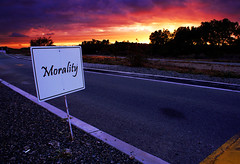
Morality
Morality (Photo credit: joel duggan)


I got involved briefly this week in a discussion on Liberal Conspiracy on the subject of forcing ISPs to block porn sites. The move has been mooted by the British government this month as part of its "pro family" agenda. (Incidentally, have you ever met a politician who described themselves as anti-family?)

The blog post at Liberal Conspiracy was implicitly against the idea of blocking such sites, but focused more specifically on the fact that it was those pesky Christians again who had been conducting research into the feasibility of such a move. The article's title - The Religious Fanatics Behind the Tory Plan to Block Porn - gives a slight hint of where the author was likely to go on the subject.

In the course of the discussion (299 comments and counting) "pagar" made the following assertion:

"Morality is a matter for the individual, not the collective."


I replied to pagar:

"Really?

Opposition to murder, rape and human trafficking are just three of the behaviours that require a collective morality."


To which pagar answered: 

"No.
These things are legitimately matters for a collective legal system not because they are “immoral”, but because they involve coercion, the imposition of one’s will by compulsion."


Pagar's comment, in my opinion, goes to the heart of the liberal dilemma. On the one hand, s/he wishes to reject the idea of a universal or community-wide morality, replacing it with a radically individualised idea of personal rights. On the other hand, pagar appeals to an implicit universal moral ethic (namely, that it is wrong to use coercion on another) as the reason why law should be enforced against murders and traffickers.

Pagar and others who argue this way may or may not have thought long and hard about "why" they assume that not coercing people is wrong in itself, and therefore the basis for law.(Let's lay to one side for now the fact that all state-sanctioned law involves coercion. Try not paying your tax next year for proof of this reality.)

It may be argued that it is "obvious" that imposing one's will by coercion is "a bad thing". I would strongly agree, but unlike the secular liberal, I am not satisfied with such a subjective answer alone. In the Middle Ages, it was "obvious" that people were born unequal and should be treated differently under the law. In the 18th century it was "obvious" (even to such apparently enlightened figures as Thomas Jefferson) that the "negro" was "innately inferior" to the white man.


Portrait of Thomas Jefferson by Rembrandt Peal...
Portrait of Thomas Jefferson by Rembrandt Peale, 1805. New-York Historical Society. (Photo credit: Wikipedia)

By stating what one regards as "obvious" as the basis for an absolute moral code, imposed by the force of the state, a whole number of miserable and oppressive policies can be and have been imposed.

So, I agree with pagar that coercion of one individual on another is wrong (with the proviso that all law involves coercion). Where I differ from him/her is the denial that such an assumption is an example of a collective morality. Simply put, people's view that it is wrong to kill and rape rests upon a moral assumption which the community must subscribe to in order for the view to find expression in tangible legal rights.

It seems that when humans come together to form societies, they cannot help but establish communal codes of acceptable and unacceptable behaviour. To deny this seems to me to fly in the face of the evidence of history.

Those who deny the need or reality of a communal morality end up, it seems to me, creating one anyway. The commitment to individual rights rests upon a community-wide acceptance that such rights do in fact exist. In effect, communal morality at its best upholds and underpins these rights and freedoms. Denying communal morality seems to me a philosophical and political dead end.

Which, if I'm right, begs the question, "What is the communal morality and where does it come from?"

But that's for another day. 


If you enjoyed this post, get free updates by email or RSS.
Enhanced by Zemanta

Wednesday, December 01, 2010

Why Wikileaks is Good for Democracy

Cropped version of Thomas Jefferson, painted b...Image via Wikipedia


Information is the currency of democracy.
-Thomas Jefferson


Since 9/11, the US government, through Presidents Bush and Obama, has increasingly told the US public that "state secrets" will not be shared with citizens. Candidate Obama pledged to reduce the use of state secrets, but President Obama continued the Bush tradition. The courts, Congress and international allies have gone meekly along with the escalating secrecy demands of the US Executive.

By labeling tens of millions of documents secret, the US government has created a huge vacuum of information.

But information is the lifeblood of democracy. Information about government contributes to a healthy democracy. Transparency and accountability are essential elements of good government. Likewise, "a lack of government transparency and accountability undermines democracy and gives rise to cynicism and mistrust," according to a 2008 Harris survey commissioned by the Association of Government Accountants.

Into the secrecy vacuum stepped Private Bradley Manning, who, according to the Associated Press, was able to defeat "Pentagon security systems using little more than a Lady Gaga CD and a portable computer memory stick."

Manning apparently sent the information to Wikileaks - a nonprofit media organization that specializes in publishing leaked information. Wikileaks in turn shared the documents to other media around the world, including The New York Times, and published much of the documents' contents on its website.

Despite criminal investigations by the U.S. and other governments, it is not clear that media organizations like Wikileaks can be prosecuted in the U.S., in light of the First Amendment. Recall that the First Amendment says: "Congress shall make no law respecting an establishment of religion, or prohibiting the free exercise thereof; or abridging the freedom of speech, or of the press; or of the right of the people peaceably to assemble, and to petition the government for a redress of grievances."

Outraged politicians are claiming that the release of government information is the criminal equivalent of terrorism and puts innocent people's lives at risk. Many of those same politicians authorized the modern equivalent of carpet bombing of Baghdad and other Iraqi cities, the sacrifice of thousands of lives of soldiers and civilians and drone assaults on civilian areas in Afghanistan, Pakistan and Yemen. Their anger at a document dump, no matter how extensive, is more than a little suspect.

Everyone, including Wikileaks and the other media reporting on what the documents reveal, hopes that no lives will be lost because of this flood of information. So far, it appears those hopes have been met: McClatchy Newspapers reported November 28, 2010, that "US officials conceded that they have no evidence to date that the [prior] release of documents led to anyone's death."

The U.S. has been going in the wrong direction for years by classifying millions of documents as secrets. Wikileaks and other media that report these so-called secrets will embarrass people, yes. Wikileaks and other media will make leaders uncomfortable, yes. But embarrassment and discomfort are small prices to pay for a healthier democracy.

Wikileaks has the potential to make transparency and accountability more robust in the U.S. That is good for democracy.


Written by Bill Quigley and re-produced under a Creative Commons Licence from Truth Out


If you enjoyed this post, get free updates by email or RSS.