Showing posts with label ethics. Show all posts

Tuesday, October 09, 2012

Eating for the Kingdom: The Other Journal


Interesting, if lengthy, article at The Other Journal moving forward the discussion on food, ethics and the Kingdom of God.


Includes the best one-paragraph summary of a Biblical view of "our relationship with nonhuman animals" that I've come across. Here it is:


Humans are created alongside other animals who are also given spirit by their Creator (Gen. 1:30). Permission for humans to eat animal flesh is not received until after the flood (9:2-3), coming in the context of God’s recognition of human sinfulness and alongside the proscription of murder (9:6). The attendant rituals of sacrifice (9:4) make visible the death of the individual animal (9:5), reinforcing the intimate commonality between humans and other animals, something modern factory farming deliberately attempts to obscure. Even more notable with reference to Genesis 9 is the covenant in which God promises to be with Noah “and with every living creature that is with you” (9:10); activity which finds a parallel in Hosea, wherein God makes a covenant “with the wild animals” on Israel’s behalf (Hosea 2:18). Job’s protestations about the injustices of life are met with a divine response that puts Job in his place as one animal (albeit one made in God’s image) among many, from the horse to Leviathan (Job 38–41). In Jonah, God exhibits concern for the animals of Nineveh (Jon. 4:11), who themselves are clothed in sackcloth, participating in the confession and lamentation of that city (3:7–8). Eschatologically, Isaiah (11:6–9 and 65:25) and Revelation (5:13) describe humans and animals living peaceably in relationship in visions of the kingdom to come. Paul, often criticized by vegetarians for his proclamations on diet, affirmed that the whole creation is “groaning in labor pains” awaiting “the redemption of our bodies” (Rom. 8:22–23) and that through the blood of Christ, God has reconciled “all things” to himself (Col. 1:20).


If you enjoyed this post, get free updates by email or RSS.

Thursday, May 10, 2012

Porn, Morality and the Liberal Dilemma

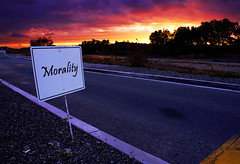
Morality
Morality (Photo credit: joel duggan)


I got involved briefly this week in a discussion on Liberal Conspiracy on the subject of forcing ISPs to block porn sites. The move has been mooted by the British government this month as part of its "pro family" agenda. (Incidentally, have you ever met a politician who described themselves as anti-family?)

The blog post at Liberal Conspiracy was implicitly against the idea of blocking such sites, but focused more specifically on the fact that it was those pesky Christians again who had been conducting research into the feasibility of such a move. The article's title - The Religious Fanatics Behind the Tory Plan to Block Porn - gives a slight hint of where the author was likely to go on the subject.

In the course of the discussion (299 comments and counting) "pagar" made the following assertion:

"Morality is a matter for the individual, not the collective."


I replied to pagar:

"Really?

Opposition to murder, rape and human trafficking are just three of the behaviours that require a collective morality."


To which pagar answered: 

"No.
These things are legitimately matters for a collective legal system not because they are “immoral”, but because they involve coercion, the imposition of one’s will by compulsion."


Pagar's comment, in my opinion, goes to the heart of the liberal dilemma. On the one hand, s/he wishes to reject the idea of a universal or community-wide morality, replacing it with a radically individualised idea of personal rights. On the other hand, pagar appeals to an implicit universal moral ethic (namely, that it is wrong to use coercion on another) as the reason why law should be enforced against murders and traffickers.

Pagar and others who argue this way may or may not have thought long and hard about "why" they assume that not coercing people is wrong in itself, and therefore the basis for law.(Let's lay to one side for now the fact that all state-sanctioned law involves coercion. Try not paying your tax next year for proof of this reality.)

It may be argued that it is "obvious" that imposing one's will by coercion is "a bad thing". I would strongly agree, but unlike the secular liberal, I am not satisfied with such a subjective answer alone. In the Middle Ages, it was "obvious" that people were born unequal and should be treated differently under the law. In the 18th century it was "obvious" (even to such apparently enlightened figures as Thomas Jefferson) that the "negro" was "innately inferior" to the white man.


Portrait of Thomas Jefferson by Rembrandt Peal...
Portrait of Thomas Jefferson by Rembrandt Peale, 1805. New-York Historical Society. (Photo credit: Wikipedia)

By stating what one regards as "obvious" as the basis for an absolute moral code, imposed by the force of the state, a whole number of miserable and oppressive policies can be and have been imposed.

So, I agree with pagar that coercion of one individual on another is wrong (with the proviso that all law involves coercion). Where I differ from him/her is the denial that such an assumption is an example of a collective morality. Simply put, people's view that it is wrong to kill and rape rests upon a moral assumption which the community must subscribe to in order for the view to find expression in tangible legal rights.

It seems that when humans come together to form societies, they cannot help but establish communal codes of acceptable and unacceptable behaviour. To deny this seems to me to fly in the face of the evidence of history.

Those who deny the need or reality of a communal morality end up, it seems to me, creating one anyway. The commitment to individual rights rests upon a community-wide acceptance that such rights do in fact exist. In effect, communal morality at its best upholds and underpins these rights and freedoms. Denying communal morality seems to me a philosophical and political dead end.

Which, if I'm right, begs the question, "What is the communal morality and where does it come from?"

But that's for another day. 


If you enjoyed this post, get free updates by email or RSS.
Enhanced by Zemanta

Sunday, December 11, 2011

Why 98% of abortions in Britain are now technically illegal.


Whatever your views on abortion, you must read this article by Dr Peter Saunders who makes a (to me) persuasive case that the current law in the UK should be interpreted as showing that 98% of abotions in the UK are in fact in breach of the law.


If you enjoyed this post, get free updates by email or RSS.
Saturday, December 11, 2010

Christians and Wikileaks

Reaction to the Wikileaks phenomenon among Christians has been mixed, but in my observation this week, it has gravitated towards being concerned or annoyed, with a minority being outraged. A short piece by Julie Clawson on the Sojourner's website has been the only article I have read so far from a Christian perspective that sees the publishing of the leaks as a qualified good.

In reflecting on the more general view among Christians whose comments I have read this week, which express concern or hostility, I have noted a number of theological and political assumptions which are influencing interpretations of the Wikileaks project. In addition, as we shall see, there are more personal concerns being raised about the nature of security and privacy in the Internet age.

  1. A high view of government. The "key texts" of Romans 13 and 1 Peter 2 appear to represent a grid through which a deferential perspective on the role of political rulers is formed and expressed.
  2. A concern about process. I have heard some say that while they see it as helpful for the public to know the facts about how its government has been operating, they are nervous about the manner in which Wikileaks have gone about disclosing the inner workings of the state.
  3. A concern about lawlessness. The commencement of Denial of Service attacks against businesses which have withdrawn support from Wikileaks (including Amazon, Mastercard, Visa and PayPal) has, in my reading, raised the hackles of those who might otherwise be more sympathetic to the Wikileaks agenda. One church leader in the United States, for instance, has questioned whether these DOD attacks represent a "spirit of lawlessness" as described in 2 Thessalonians 2.
  4. A concern for privacy - both at the institutional and individual level. It has been interesting to hear some express concern that the leaking of the State Department's internal memos could be a step in the direction of everyone's private thoughts and correspondence being broadcast online. Interestingly, I have not come across this particular Orwellian concern being expressed by anyone other than Christian writers in the last week.


What can we deduce from the above points, and are there alternative or complementary considerations that are worth taking into account when assessing the Wikileaks phenomenon? A few broad themes present themselves:

  1. Romans 12 and 1 Peter 2 could be read against the backdrop of a New Testament that paints a rather more negative view of government than might be suggested if those two passages are taken in isolation. We see in the writing of the apostles rulers portrayed as routinely corrupt, immoral and bloodthirsty (think Herod), described as enemies of the gospel (emperors and their subordinates) and as members of an immoral world system that is under God's judgment, represented variously as a drunken prostitute and a many-headed monster.
  2. We ought to think carefully about "why" it is that many believers appear to be more troubled by the process of the leaks than they are by some of the facts they reveal. In particular, the large (and previously unreported) number of civilians who have lost their lives as a direct result of the American and British invasion of Iraq ought, surely, to be of greater concern than any loss of prestige caused to the governments that have contributed to these loses. If this is not the case, we must ask ourselves some fundamental questions about our faith and the moral priorities that arise from it.
  3. We should be careful not to equate lawlessness with disturbing the status quo. Blind obedience to rulers is not a virtue, Christian or otherwise, and all moral people will have some actions which they will not commit, even if required to do so by the State. Furthermore, we should be careful to not miss the fact that the leaks reveal spectacular acts of lawlessness on the part of those in government. Illegal phone tapping of citizens, and orders to obtain biometric data from UN diplomats, are revealed as just two of the most obvious examples of lawless activity that elected leaders stand accused of by their own official documents.
  4. We should be careful to be historically consistent when analyzing such a phenomenon as Wikileaks. It is ironic, to say the least, to hear residents of a nation birthed in an act of armed rebellion (the United Sates) denying the right of citizens to take modest action to assert their freedoms and challenge the perceived injustices of militarized and increasingly dominant governments.
  5. Concerns about individual privacy are important and valid concerns. However, the reality is that the greatest threats to our right to a private life come not from reporters such as Julian Assange, but from corporations and governments who have the power and the motive to pry, spy and intrude in ways unimaginable a generation ago. Against such a backdrop, the need for a free press (defined as one that says things some people don't want to have said) remains of paramount importance as a restraint against tyranny.


Enhanced by Zemanta

Friday, February 12, 2010