OK, let's see how we get on using Ping to update a few of my sites.
Friday, October 29, 2010
Poor Services for Poor People
Reproduced under a Creative Comons licence by permission of Stuart Weir and Open Democracy. Original article.
Nick Clegg forfeited my trust when he took his party into a coalition on an agreement to accept a deficit reduction programme that was both harsh and fast, and to shred most of his party’s election policies, including the pledge on university tuition fees. He has now won my contempt. His absurd attack on the Institute for Fiscal Studies’ analysis of Osborne’s savage package as “distorted”, “a complete nonsense” and “shrill” is wrong and distorted.
Clegg says that the Treasury presentation of the cuts package gives a “richer picture” of the interaction between taxes and benefit cuts, and public service cuts and gains than the IFS’s finding that the tax and benefits package is regressive. Yet the IFS's carefully non-partisan finding is in fact kind (as Nick Pearce shows). Once the cuts in services and job losses work their way through there will indeed be a “richer picture” – of uncountable misery and distress for thousands of households, and not necessarily only the poorest.I was already musing on the inadequacy of the coalition’s political calculus of “fairness” when the IFS report and Clegg’s response surfaced. Money and class matter. In arguing that the IFS are talking nonsense by focussing only on tax and benefits in their modelling, Clegg seems to be saying that the IFS are wrong to base their figures on how much money people actually have rather than adding in some hugely over-optimistic assumption that the “pupil premium” is going to succeed where the child trust fund failed in reducing grotesque income inequality.
The middle class has ample financial fat to cushion Osborne’s blows, the poor do not. The middle class has greater protection against losing their jobs and better terms thereafter if they do. The middle class will not be driven out of their basically secure homes in affluent areas of the country, and even into homelessness, by draconian housing benefit changes, many of the poorest will.
Study after study shows that the middle class get the most from services delivered “free” at the point of use like education and health. (Why else did the New Labour project focus on these services and neglect social housing where need enters the equation?) The middle class live in areas where the schools are better and where there are actually NHS dentists. They can go private for diagnosis if necessary, thereby “leap-frogging” NHS waiting lists and so on. The key source of the inequality in use of services is class or more specifically cash. So any serious attempt to factor in everything else would make it very clear that the poor still stand to lose most.
When I wrote on OurKingdom about the contrast between the media coverage of housing benefit caps and the child benefit cut for richer households, Stuart Wilks-Heeg wrote to say that the complaint from the middle classes about the change was important. This was the political dynamic which has kept the Scandinavian welfare state intact - almost all their benefits are universal. Everyone pays, everyone benefits - even if unequally in the UK. I hope that the Labour opposition will take this on board as they prepare their longer-term response to Osborne and will argue across the board for a universal welfare state and the security that it should bring.
Once you start to restrict entitlement to any benefit two things happen. First, government will over time lower the income threshold for people eligible to get that benefit. For those on £44,000 today, read those on £35,000 by the end of the Parliament, down to £20 by the end of the next if the Tories stay in power. The process has already begun with child benefit, now “frozen” by the coalition in spite of the Conservatives promise to retain it.
Second, as entitlement becomes more and more restricted, the benefit becomes more and more stigmatised - especially if it involves children. One Conservative minister has already said that the poor are under a duty to have fewer children. Nobody currently says that anyone has children just to get child benefit - though they already say that about access to social housing and may say it about income support. But as the change goes through, they will and their claims will become even more powerful in light of the other benefit cuts. In the USA, the political controversy over what used to be TANF (Temporary Assistance for Needy Families) grew and grew as entitlement was restricted. It ended up with Clinton imposing a two-year maximum on it, even though it was only ever 1% of American public expenditure.
Social housing has already been utterly undermined by council house sales that in effect removed better-off families and reduced the remaining, usually poorer, housing stock to catering largely for people in the more desperate need. The neglect of new building closed off the chances of many working class families of obtaining homes in their local areas. The new changes the government has announced will not only drive poor families out of affluent areas, they will also over time drive more better-off families out of social housing as rents rise. Thus what Aneurin Bevin envisaged as a universal service is now more and more a residual provision that has already become unhealthily stigmatised.
And what of the coalition’s aim to create a “big society”? I take this to mean in part that they wish to create a more cohesive society. The Danish political scientist, Gosta Esping-Andersen, has demonstrated in his book, The Three Worlds of Welfare Capitalism , that universal benefits in the Nordic welfare states were crucial in explaining cross-class solidarity in support of the welfare state. Aggressive means-testing of benefits in the USA, especially those paid to families, has had the opposite effect – each successive reform which reduces eligibility to focus resources on the “poorest” only serves to accentuate general resentment of “welfare”. Tellingly, the one aspect of the US welfare system from which high-income earners also benefit – pensions – has been virtually impossible for US politicians to take the axe to.
Thursday, October 28, 2010
Wednesday, October 27, 2010
Will the Housing Benefit Cap Become the New Poll Tax?
The proposal would limit the amount that could be paid to an individual to one third of the average rental income of the area where the claimant lives. At present, the claim is capped at half of the local average.
The government's assertion is that it is "not fair" for a jobless person to be able to live in a property (for instance in central London) that a working person would not be able to afford. Which, taken in isolation as a philosophical statement, is possibly worth debating. But, put in context of the real world and the actual economy, translates to an outcome that seems as cruel as it is unfair.
Under the proposed change, a family (for instance) who were claiming housing benefit in an expensive area would be unable to continue to receive the payment if it ran above the new capped level, meaning that they would probably have to move out and find cheaper accommodation.
The problem with that is that, in most cities, such a move would require a significant relocation to a poor estate on the edge of the city, or out of the city altogether.
This would result in a number of undesirable outcomes:
- the claimant would be further removed from the geography of the job market which they need to access in order to move out of benefit and into work (which is a key idea in the government's welfare reform plans)
- the claimant (and family) would be removed from their existing relational networks and social support systems - important aspects of the Big Society - which would make it more difficult for them to escape poverty and its attendant evils
- children of such claimants would be removed from existing peers, school and other support systems, which are particularly important when a family are on a low income, and which take time to reproduce elsewhere
- cities would become increasingly segregated economically. Do we really want to see a Paris-style urban settlement, with the poor pushed out to the physical periphery of the city, leaving the heart exclusively for the rich? British cities are already economically segregated to a significant degree and this proposal will make it much worse, with the social upheaval that such a move would bring in its wake.
- the recipient neighborhoods, many already dealing with high levels of crime, drug misuse and social breakdown, would receive an influx of non-working households who are geographically uprooted, possibly resentful and less able to access employment than they may have been before their move. This is hardly a recipe for building safe and cohesive local communities.
Let's hope that IDS has the sense to scrap this unjust measure. Failure to do so could be a catalyst for the kinds of protest and disorder that accompanied the last great nationally unpopular policy from a Conservative government. The Poll Tax ultimately failed because it was widely perceived as unjust. It is to be hoped that this housing benefit measure receives the same treatment, before it is implemented and its ill effects felt across our cities.
If you enjoyed this post, get free updates by email or RSS.
Related articles
- Housing benefit cap 'may change' (bbc.co.uk)
- Letters: Our fears over the housing benefit cuts (guardian.co.uk)
- Benefits cut, rents up: this is Britain's housing time bomb (guardian.co.uk)
- Nick Clegg rejects social 'cleansing' claims (news.bbc.co.uk)
Tuesday, October 26, 2010
Unmasking the Tea Party
Image via Wikipedia
The film can be viewed here and is previewed below.
Interested to note that the story of the Koch brother's backing to the Tea Party, which is committed to wrecking Obama's domestic agenda, is also now receiving coverage in the British press - as evidenced by this article by George Monbiot in today's Guardian.
If you enjoyed this post, get free updates by email or RSS.
Sunday, October 24, 2010
Aki Ra: DIY Landmine Clearance Hero
Thanks to Ben Thomson for alerting me to this incredible individual. Check out the video and read Ben's tribute here. Ra estimates that he has personally cleared about 50,000 landmines himself, and has trained over 1,000 fellow Cambodians to do the same, using low tech tools and methods.
As kingmanjim comments on YouTube, "How did Obama get the Nobel Peace Prize with this guy around?"
If you enjoyed this post, get free updates by email or RSS.
Friday, October 22, 2010
Obama's Escalating Robot-War in Pakistan Endangers Us All : Johann Hari
This is the best article I have yet read that intelligently critiques the "drone wars" in Pakistan and elsewhere.
Disturbing and compelling reading.
Wednesday, October 20, 2010
It's Logical to Be 'Islamophobic'
Interesting, controversial article on the logic, reasons and solutions to islamophobia.
If you enjoyed this post, get free updates by email or RSS.
Sunday, October 17, 2010
BBC Sport - Football - Fifa officials 'offer to sell 2018 World Cup bid votes'
Image by Downing Street via Flickr
I'm afraid that this story does not come as a great surprise.
The vast amounts of money involved in the professional game, combined with what appears to the outsider as a lack of transparency and accountability inside FIFA, the sport's governing body, make stories like this almost inevitable.
That's quite apart from the fact that human beings are often greedy, dishonest and corrupt.
How about a return to amateurism across all sports?
Related articles
Friday, October 15, 2010
Education, Skill Sharing, Self Learning and Tuition Fees in England
This week, education came back into the political spotlight in the UK in a big way with the publication of the Browne Review on the future of higher education funding in England. The report, which looks likely to shape the policies of the current coalition government, proposes a "shake up" (why does public policy always need to be shaken? Why can't it be planned, and thought through strategically?) in the way that higher education is to be funded in the coming years.
The Review's headline recommendation is to allow universities to charge more for their courses - up to £7,000 per year for an undergraduate programme.
One consequence of this, if the proposal is adopted as government policy , is that poorer children will be de-motivated from attending university (in my opinion) despite low-interest loans for students from low-income families.
It is difficult for government ministers to appreciate, since many of them are millionaires, how terrifying the idea of debt is in any form to an 18-year old from a family who have no savings, who live from hand to mouth and who make a living in the informal sector. The tuition fee amount is not the issue. The requirement to become indebted is the issue.
Coinciding with the publication of Browne, I read a fascinating report by Latitude Research and Shareable magazine titled The New Sharing Economy. The report's thesis is that online sharing, of digital media and goods, is proving a catalyst for offline sharing of tangible commodities such as cars, workspace and household utilities. The transition, in its infancy, is described as being "from an ownership to an access economy" in which "use" will prove more important than "possession."
Applying this idea to my own sphere of education - and inspired by several examples I have come across from the US - I have been thinking for some time about running a "skill-share" day here in Bristol, primarily among families I work with through my business and others I know in the wider community.
A skill share is an event at which people with knowledge or abilities pass on what they know to others who would like to learn them, in a mutual, non-fee paying environment. Everyone teaches; everyone learns.
Thinking about the families I currently work with, whose main earners include doctors, warehouse operatives, professors, taxi drivers, cleaners and small business owners, I have been amazed when I consider how many skills they possess. They speak over twenty languages between them, they can cook, change plugs, programme computers, break dance, do business accounts, fix cars, fund raise, run marketing campaigns, analyze ancient texts, play musical instruments, create software, make furniture, grow food, negotiate, manage, repair cycles, administer first aid, and create works of art. And that's just for starters.
A skill share would bring together - for a day, on a drop-in basis - people who want to share "how to" with people who want to learn "how." I imagine a rolling programme throughout a Saturday, with maybe four or five sessions running at the same time, for forty minutes at a time. People attend what they would like to and come and go as they wish. The day could benefit from some tasty food and drink served throughout, to add to the social ambiance of the event.
As this was going round my head, I stumbled upon this fantastic video by Sir Ken Robinson, placing today's education practices in their historic and economic context and suggesting the direction of new paradigms needed in education if the many are not to be excluded from the learning process in the future. I hope I'm not exaggerating when I say that this short video is the best introductory piece of education philosophy I have ever come across. Brilliant.
Paradigms are notoriously difficult to change, and if they do change, the process usually begins with small groups of visionary individuals on the fringe, rather than with major changes at the centre. Visionaries such as Dr Sugata Mitra, who wanted to test a hypothesis:
The acquisition of basic computing skills by any set of children can be achieved through incidental learning provided the learners are given access to a suitable computing facility, with entertaining and motivating content and some minimal (human) guidance.
By placing an Internet-ready computer in the outer wall of his office in Delhi, which enabled children from the nearby slum to access it without supervision or restriction, Dr Mitra's discovery was that the children taught themselves how to read and develop computing and maths skills unaided by a teacher.
Self-learning is at the heart of the Kumon method of learning, in which I am an Instructor. I don't formally teach any of the 100 children I see every week. They teach themselves, with appropriate material and appropriate guidance, lightly given.
I guess the various strands of this rambling post come together in the following convictions: that traditional industrial-style education is creaking at the seams, that the on-going pressure on public finances is going to make this model even more difficult to sustain, and increasingly difficult for many to access at higher education levels. Beyond this, grass-roots community-based skill sharing, and carefully conceived self-learning programmes, may provide some of the ways through for discovering the new paradigms needed in our age. It goes without saying that the Internet provides a platform for these two strands - self-learning and free learning - to come together massively, and that we have only begun to scratch the surface of how these could combine in the future.
What do you think?
If you enjoyed this post, get free updates by email or RSS.
Related articles
- Browne review: Universities warned to expect £4.2bn cuts (guardian.co.uk)
- Funding cut, fees up and higher education for sale (independent.co.uk)
- Tuition fees free market 'unfair' (bbc.co.uk)
Thursday, October 14, 2010
Chilean Mine Rescue: Spreading the Love
Image via Wikipedia
- the world's media. It has been a relatively easy story to report on - with a permanent media centre on site, a stable physical environment, a predictable timetable of events and a wonderful human interest story (with inevitable spin offs into profiles of the miners and their families). Certainly an easier story to report on than, say, the war in Somalia. Having said that, it appears from a leaked email published on today's Guardian that the BBC have overspent on their Chile mine story - a situation which BBC World News editor Jon Williams describes as "serious".
- the President of Chile. Sebastian Pinera has not been backward in coming forward, as the world's media have focused in on this good news story in his backyard. I even noticed one BBC report describing him as the "leader" of the rescue. I would be very surprised if that were an accurate description of his role, but the political capital that has rubbed off on the 61-year-old Harvard graduate has been considerable.
- the popular psychology industry. Although I do not agree with everything Brendan O'Neill says on the subject (here), he does raise some important questions about the allegedly authoritarian role played by the 300-plus medical and psychology professionals who "supported" the miners from the top. In particular, claims that letters from family members were withheld from certain miners because of their potential to damage the psychology of individuals underground, are, if true, a cause for concern. Nonetheless, the world's media have predictably wheeled on their chosen experts to explain how the miners must have been feeling - thus reinforcing the power of such professionals and meeting a felt need for ever more intrusive public access into the very souls of those making the news.
My personal favourite anecdote from the mine story is of the t-shirts worn by the miners on their rescue. I'll let my friend Heidi Chase (Spanish speaker and oft-times South American resident) summarize from her facebook profile:
“Written on the back of the t-shirts the Chilean miners were wearing as they came to the surface…
“Porque en su mano están las profundidades de la tierra, Y las alturas de los montes son suyas”
(Because in His hand are the depths of the earth and the heights of the mountains are His) Psalm 95 V4”
If you enjoyed this post, get free updates by email or RSS.
Wednesday, October 13, 2010
When the Chilean Miners Arrived for Work
- BP had finished pumping cement into its damaged oil well in the Gulf of Mexico
- Italian prime minister Silvio Berlusconi survived a no confidence vote in Parliament
- The UN sent its special envoy to Pakistan to asses the damage caused by the country's worst flooding in living memory
- 600 wildfires were continuing to burn in Russia following a record summer heatwave
- Liverpool beat Macedonian side Rabotnicki in the qualifying campaign for the Europe League
- The US Senate confirms Elena Kagan's nomination to the Supreme Court - the third woman to serve on America's highest court
- England's cricket team were about to start their second test against Pakistan at Edgbaston
If you enjoyed this post, get free updates by email or RSS.
Related articles
- First rescuer reaches Chilean miners (bbc.co.uk)
Sunday, October 10, 2010
Is Sharing the New Owning?
Motives are partly to save money and also to improve the world, through strengthening relationships and reducing consumption.
Report courtesy of Latitude Research and Shareable Magazine.
If you enjoyed this post, get free updates by email or RSS.
Related articles
- In "The New Sharing Economy" CC is the norm (creativecommons.org)
- The New Sharing Economy (life-connected.com)
- Has Online Sharing Spurred a New Offline Sharing Economy? (nytimes.com)
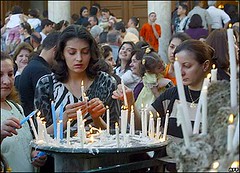
A Spiritual Legacy of the Iraq War
Image by jimforest via Flickr
According to the Assyrian International News Agency, "During the reign of Saddam Hussein, the estimated 1.4 million Christians - many of them Chaldean-Assyrians and Armenians, with small numbers of Roman Catholics - were generally left alone if they didn't oppose the government and they lived in relative peace with the country's Sunnis and Shiites."
Since 2003, by contrast, "Christians specifically were targeted by Church bombings and assassination attempts owing to a perceived association with the aims and intentions of the occupying forces", according to Dr. Kristian Ulrichsen, an Iraq expert at the London School of Economics.
Low-lights of this targeting of Iraqi Christians have included:
- a wave of attacks on church buildings in 2004
- the beheading of a priest in Mosul
- the murder of 40 Iraqi Christians in January 2009
- the killing of 10 Christians in Mosul in the run up to the March elections.
With up to half a million Christians having fled the country, says Ulrichsen, "There's a real possibility that 2,000 years of settlement by Christian communities in Iraq is in danger of near-total extinction."
If you enjoyed this post, get free updates by email or RSS.
Related articles
- Iraqi Christians flee homeland even as war fades (reuters.com)
- Bishop Andraos Abouna: Priest who worked with Iraqi Catholics in London and war-torn Baghdad (independent.co.uk)
- Iraqi Christians fleeing persecution (greenreview.blogspot.com)
Thursday, October 07, 2010
Dismantling the NHS?
Image via Wikipedia
The claim that the long-term outcome of these reforms is a two-tier health service, with only a limited range of treatments available for all, is hard to avoid.
Worth a read.
If you enjoyed this post, get free updates by email or RSS.
Sunday, October 03, 2010
Shrinking Arctic Ice Drives Walrus to Land
If you enjoyed this post, get free updates by email or RSS.