Showing posts with label Catholic Church. Show all posts

Saturday, July 28, 2012

London's Olympic Opening Ceremony Unwrapped - for the Benefit of the Rest of the World

American sprinter Michael Johnson summarised the issue when asked on the BBC whether the rest of the world would "get" the messages of London's Olympic opening ceremony. Since he worked and travelled here often, Johnson replied, he felt he could appreciate it at a cultural level, but he thought that many of his fellow Americans and the rest of the world would not.

Or, as one contributor put it on Twitter: "This is just plain weird."
 
So, without further ado, here is the opening ceremony unwrapped, for an international audience.

The key to interpreting director Danny Boyle's extravaganza, in my view, is to understand the opening scene. While the crowds filtered into the stadium in the hours before the official start, they were greeted with a stadium filled not with ranked masses of drummers or dancers, but by a green field on which grazed sheep, cattle and goats, tended by farmers and labourers dressed in outfits reminiscent of pre-industrial Britain. Bearded gentlemen played cricket on a village green; white clouds floated gently over the idyllic pastoral scene.


source: gorgeaux


The official opening of the ceremony involved the singing of the traditional English anthem Jerusalem, supplemented by national songs of Wales, Scotland and Northern Ireland. 

Written by nineteenth-century poet, artist and mystic William Blake, the words of his poem And Did Those Feet were put to music by Hubert Parry in 1916. The song - known ever since simply as Jerusalem - has come to be widely adopted as an unofficial national anthem for England, sung regularly at international sports matches, and even at the wedding in 2011 of Prince William and Catherine Middleton.

The poem has been sung at party conferences by several of the main political parties since the second world war. The song Jerusalem has come to be seen as critical of the damaging effects of industrialisation and of the consolidation of economic power by a landed, industrial and ecclesiastical elite. Blake, raised as a Moravian, was a life-long critic of the established Church of England. In place of such a history, Jerusalem articulates an alternative vision of England - one shaped at every level by the mysterious presence of Christ.


And did those feet in ancient time.
Walk upon England's mountains green:
And was the holy Lamb of God,
On England's pleasant pastures seen!


Drawing on mythical themes such as the visitation of Jesus as a youth to the British Isles, accompanied by his supposed-uncle Joseph of Arimathea, the poem combines religious, mystical and political themes and has come to be seen as expressing a longing for a just, political and economic settlement in the British Isles, infused with Christian ideals.


I will not cease from Mental Fight,
Nor shall my Sword sleep in my hand:
Till we have built Jerusalem,
In England's green and pleasant Land


This imagery was not lost on the British audience last night. Phillip Blond, author of the influential book Red Tory: How Left and Right have Broken Britain and How we can Fix It, was tweeting lyrical throughout the ceremony. The political think-tanker, economist and one-time theologian enthusiastically tweeted of the opening scene's imagery representing


"A pre-enclosure and pre-capitalist haven - this is already so political - magnificent - romanticism at our heart."


Daily Telegraph blogger Tim Stanley, meanwhile writes of the opening scene's depiction of


"The brutal uprooting of rural Britain. Was this written by GK Chesterton? It's fantastic."


Blond affirms this interpretation of British history:


"It's essentially a Catholic theory of British history" which sees "enclosure as the original crime." 


The idea that the enclosure of common agricultural lands from the 16th to 19th centuries is a root of much of Britain's current economic problems was explored in the early twentieth century by Roman Catholic social theorists such as Chesterton and Hilaire Belloc. More recently, socialist historian EP Thompson argued in his The Making of the English Working Class that "Enclosure (when all the sophistications are allowed for) was a plain enough case of class robbery."
 
It is perhaps not coincidental to learn that Boyle himself was raised in a Catholic household in the north of England and was at one time considering attending seminary to become a priest.
 
Much else that followed in last night's Olympic extravaganza was a re-telling of this British story. The achievements of the industrial revolution, for instance, were set alongside the fruits of its ugly expression in the efficiency of modern warfare.

The idea that the common assets of the British working class have been appropriated by their rulers continued through the ceremony's subsequent tableaux. Although framed in terms of children's fairy tales, dreams and nightmares, the lengthy section filled with nurses, pyjama-clad children in hospital beds, and frightening apparitions appeared linked to the story of the enclosures. The message was that Britain's greatest human asset - its National Health Service - is under threat from dark forces.


Source: Julie70


The allusion to the highly controversial NHS reform bill recently passed through Parliament - which gives greater access to the Service to private companies, and which was strongly opposed by all of the main professional medical organisations - will not have been lost on a British public widely dissatisfied with the legislation brought in under the current coalition government. The implication that J.K Rowling's Lord Voldemort could be compared to health secretary Andrew Lansley was both excruciating and exquisite.

That a fictional character - the magical Mary Poppins - was instrumental in driving away the threats to the sick children illustrates an additional strand within Boyle's ceremony, namely that of the British romantic tradition. As blogger Cath Elliott noted:

"So Mary Poppins bravely fought off the tories and saved the NHS. Or something."


Romanticism was a key element in William Blake's creative work, expressed in part in Boyle's opening ceremony through humour. Rowan Atkinson, James Bond and the Queen parachuting into the stadium were all part of this tradition of self-deprecating British humour. Mr Bean also performed the first scripted fart at an Olympic opening ceremony. Blond again:


"And it just gets better - this is the true Britain - romantic, visionary and arcadian - and very very funny." 

 
Comparisons with the opening ceremony in Beijing four years earlier are inevitable and the contrast between creative London's story-telling and formal massed ranks of well-drilled citizens could not have been greater.

The ceremony was visionary in the best sense of the word - even as William Blake saw visions throughout his unconventional life. Here was a view of modern Britain with Christian and egalitarian roots, overcoming the forces that would create a harsher, more oppressive future.


William Blake's etching/watercolour "Anci...
William Blake's etching/watercolour "Ancient of Days" ( Wikipedia)

The young artist George Richmond was at the bedside of his visionary mentor and friend William Blake when he died in 1827 and describes the scene in moving detail:

He died ... in a most glorious manner. He said He was going to that Country he had all His life wished to see and expressed Himself Happy, hoping for Salvation through Jesus Christ.
– Just before he died His Countenance became fair. His eyes Brighten'd and he burst out Singing of the things he saw in Heaven.


Danny Boyle has expressed things slightly differently: "We can build Jerusalem. And it will be for everyone."


If you enjoyed this post, get free updates by email or RSS.
Enhanced by Zemanta

Monday, July 25, 2011

Anders Breivik and the Christian Nationalist Heresy

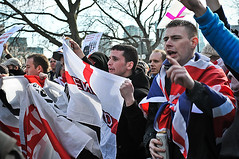
EDL march in support of Geert Wilders 05.03.10Image by belkus via Flickr


Anders Breivik, the alleged perpetrator of Norway's first domestic terror attack and worst act of violence since the second world war, is being widely described across the media as a "Christian fundamentalist" and a "conservative". Initial speculation by The Sun newspaper, the Daily Mail and CBS that the terror attacks were the work of al-Qaeda affiliates was it seems (not for the first time) a premature conclusion.

As a committed Christian myself, it is always distressing to hear the word "Christian" and "terrorism" appearing in the same sentence. I imagine the vast majority of Muslims can relate to that feeling.

So painful is it to consider the possibility that a professed follower of Christ could willfully arm himself with firearms and fertilizer bombs and, in a calculating fashion deliberately murder scores of innocent people, that it is understandable why some fellow-Christians will instinctively respond to recent events by saying, "He was not a real Christian." Indeed, many people who are not Christians would tend to instinctively come to the same conclusion. 

Such a knee-jerk reaction is understandable. Rightly so, we want to draw a sharp distinction between the murdering fanatic and the peaceable majority, who overwhelmingly reject and abhor the acts of destruction carried out by an apparently lone individual in the name of extremist politicised religion.

Rise of "Christian" Nationalism

Beyond these attempts at distancing themselves from the terrorists, however, European Christians have been reminded through Breivik's outrage of the theological and political challenge, perhaps hitherto ignored, of the rise of the heresy of extreme "Christian" nationalism.

Although there are parallels between this pan-European movement and similar white supremacist movements in the United States (epitomised by the Ku Klux Klan), the roots and manifestation of these two strands are sufficiently distinct to warrant separate investigation. For the purpose of this article, I will focus on the European dimension to the rise in the heresy of ultra-right "Christian" nationalism.


Anders Breivik himself states (in the file-sharing site document.no, to which he has been a regular contributor): 

"I myself am a Protestant and baptized/confirmed to me by my own free will when I was 15. But today's Protestant church is a joke. Priests in jeans who march for Palestine and churches that look like minimalist shopping centres.... The only thing that can save the Protestant church is to go back to basics." 

Andres Breivik's call for church reform illustrates the insidious nature of this heresy: like all false teachings, it clothes itself in language and themes that will resonate with some in the mainstream churches who would never endorse the actions of Norway's worst mass murderer. Like all heretics, the false prophet Anders Breivik espouses a doctrine which contains some common ground with large swathes of mainstream Christian opinion.

This superficial similarity of one aspect of his ideology should not obscure the fact that the rest of his doctrine is completely at odds with the teaching of the Bible and with the mainstream of historic and modern Christian teaching and practice.

Right-Wing Critique

His views share common ground with others on the political right who are critical of multi-culturalism, large scale non-European immigration and what they see as a Marxist-based cultural critique of western history and institutions. Although not terrorists, these themes are discernible in the work of such conservative writers as Bruce Bawer, Melanie Phillips, Mark Steyn, Geert Wilders, Theodore Dalrymple, and Robert Spencer. Some include in their critique the specific idea that Muslims, multi-culturalists, supporters of the European Union and social democrats are part of a plot to undermine Europe’s Christian civilization.

Christians in this respect are at particular risk of being roped into this extremist narrative, in the same way that many within the German churches fell prey to Nazi ideology in the 1930s, or who at least failed to offer a robust theological and political critique of it. Christians should note with concern, for instance, the willingness of some on the far right to employ Christian themes, symbols and  narratives in their search for political influence. It is as bizarre as it disturbing that  the Church of England General Synod found it necessary in 2009 to explicitly ban membership of the BNP on the part of its clergy. 

Secretive

As an aside, it is worth noting that, like Hitler, whose "final solution to the Jewish question" was not central to his public policy at first, the Breivik brand of "Christian" nationalism does not make explicit (until now) the true nature of its doctrines of Nordic and Aryan racial purity which underpin its critique of multi-culturalism.

Elsewhere on Document.no, for instance, Breivik notes that he adheres to the Vienna School of thought on cultural conservatism - which he summarises as avoiding the advocacy of racist-based politics, but achieving the same outcome by emphasising that islamisation and multi-culturalism are themselves racist. In approaching public policy in this duplicitous manner,  Breivik demonstrates the traits of cult leaders through the centuries who have not been explicit and public about their doctrine, but who have only expressed their views openly once they have established power. 

In this vein, Breivik commends the tactics of Geert Wilders whose Party for Freedom emerged as the third-largest in the Dutch Parliament in last year's national elections. Breivik also commends joining the anti-islamic group Stop the Islamisation of Europe (SIOE) and is impressed by the tactics of the English Defence League who he says, have gained political ground by highlighting the alleged racist nature of multiculturalism rather than by espousing an explicit doctrine of white supremacy. Breivik states his three priorities for the conservative nationalist cause in Norway as being the creation of a conservative national newspaper, the control of non-governmental organisations in receipt of state funding and, finally, the establishment of a political party equivalent to the EDL.

The Idea of Christendom

European Christian Nationalism rests upon a toxic mix of beliefs and ideology. At its heart is the Roman Catholic, and later Protestant, idea of Christendom. This is the idea that a nation state, or an empire, can be "Christian". It includes the idea of an official state church (whether Roman Catholic as in the case of southern Europe, Lutheran as in much of Scandanavia, or Anglican as in the UK). The idea has its roots ultimately in the supposed conversion of the Emperor Constantine in the early fourth century and the Edict of Thessaloniki 70 years later which made Christianity not only legal, but the only permitted religion of the Empire.

The church's transition in less than a century from persecuted to persecutor is well expressed in the text of the Edict:
“According to the apostolic teaching and the doctrine of the Gospel, let us believe in the one deity of the Father, the Son and the Holy Spirit, in equal majesty and in a holy Trinity. We authorize the followers of this law to assume the title of Catholic Christians; but as for the others .... they will suffer in the first place the chastisement of the divine condemnation and in the second the punishment of our authority which in accordance with the will of Heaven we shall decide to inflict.”

Although the church and the state were understood as having separate functions within the life of the nation or empire, in practice, the presence of an "official" religion through the medieval and modern period in many western European countries has resulted in the creation of a mindset that equates the one with the other. Even today, in an increasingly secular continent, many millions of citizens will describe themselves by default as belonging to the official state-sanctioned church. To be British is still mistakenly seen by millions as to be Christian.

Confusion, Nominalism and Persecution

As well as contributing hugely to nominalism within the church, such a confusion between the nation state and the church has also historically had a devastating effect on the nations that adhere to it, as well as to their neighbours. The violent expulsion of England's small Jewish community during the reign of Edward I in 1290, for instance, was one of numerous acts of of anti-semitism carried out in the name of Christianity in medieval and modern Europe. The Crusades has a similar theological underpinning.

In the post 9-11 age, the resurgent idea of European Christendom has Islam rather than Judaism in its sights. To be "anti-immigration" in modern Europe is code for being "anti-Muslim immigration."


Brevik's conservative doctrines bear out this view. The manifesto 2083: a European Declaration of Independence was published online on the day of the attacks in Norway and is being claimed as the work of Breivik, written in English under the name Andrew Berwick.  Even if this proves not to be the case, its content is relevant to the discussion on the characteristics of Europe's right-wing extremists. The document is heavily focused on anti-Muslim rhetoric, with over 900 references in its pages, the vast majority pejorative.

Included in the Declaration's critique of multiculturalism, Marxism and Islam is a complaint about the rise of liberal approaches to the Bible in European universities, describing undergraduate courses such as "The Bible as Literature" as a "course designed to denigrate the Bible as cleverly crafted fiction instead of God's truth."

It is common for theologically conservative Christians to express similar concerns about the denigration of the Bible, a fact which  makes the Breivik/Berwick heresy particularly insidious, by mixing falsehood alongside truth in a seamless whole.

The Deception of Common Ground

This appearance of common ground between the extreme right and conservative elements within the churches can be reinforced by a narrative that portrays Christians as increasingly victims of secular policies and laws (such as those promoting gay rights) that are increasingly discriminatory to Christians. In such a charged environment, a simplistic narrative that links individual rulings at employment tribunals with a meta-narrative of a Muslim-Marxist-multi-cultural takeover of Europe are as insidious and harmful as they are appealing to some who are already pre-disposed to a conservative mindset.

As Simon Barrow of think tank Ekklesia notes, Christians must urgently respond to these trends by acknowledging, addressing and combating,

"the sometimes disturbing links in our midst between ideological 'Christianism' (as I think it deserves to be called), anti-foreigner nationalism, and the growth of a sometimes naive and sometimes malevolent 'Christianophobia' narrative. The latter can be seen emerging as talk of 'Christian persecution' within Britain. It is part of a fearful, defensive response to the growth of socio-cultural diversity in Western societies, and to the corresponding demise of a 'Christendom' culture that privileged one kind of civic religion."

The Alternative to Christendom
     
In his ground-breaking book The Reformers and Their Stepchildren , Leonard Verduin sets forth a very different approach to Christendom to that advocated by the new nationalists. The "stepchildren" of the sixteenth-century Reformation were the radical groups which not only held to a Protestant understanding of justification by faith, but who at the same time rejected the idea of a state church and of Christendom itself. In the understanding of these believers, the nation-state is, by definition, a religiously mixed entity. Although rulers throughout history have often found it expedient to adopt and promote an "official religion" held by all their subjects, Verduin shows how the radical reformers (anabaptists and independents) insisted that societies are religiously pluralistic. All they sought was the freedom to gather, preach and worship according to their consciences, without the support or the interference of state regulations, law courts or fines for the non-conformist.

The fact that many of these "third-stream" believers were themselves persecuted by both Catholic and Protestant church and secular rulers during the Reformation era highlights the essential difference between their understanding of the relationship between church and state and that of their Constantinian opponents. The model of the separation of church and state was to find its ultimate expression in the Constitution of the United States some 300 years later.

The German  Experience

More recently, the clarity and courage of the so-called "confessing church" of 1930s Germany provies another alternative to Christendom. Under the leadership of Karl Barth, Dietrich Bonhoeffer and Martin Niemoller the "confessors" separated from the official state-sanctioned Protestant church and protested its nazification of Christianity under the influence of Hitler's religious affairs minister Ludwig Muller. 

As Phil Wood notes:

"Christianity makes a poor civil religion.  Allegedly it 'enfeebled' a people.  The Nazis believed this, hence the attraction of Alfred Rosenburg's 'Positive Christianity'.  Rosenburg attempted to rid the Bible of its Jewish heritage and claimed the 'Aryanhood' of Christ.  His influence can still be traced in today's far-right groups, which espouse either outright paganism or a tractable and bastardized Christianity." 

European Protestants today should take a cautionary note of the fact that it was the writings of the much-admired German-born Martin Luther (particularly the 400th anniversary of his 95 thesis) that were used as a springboard by extremists to promote the "German Christian" (ie, Nazified) movement in the years following WWI.

Urgent Work

It is interesting to note that when Muslim-backed acts of terror take place, they are routinely described in the west as expressions of global jihad. When equally atrocious acts take place by non-Muslim white westerners, they are described as acts of deranged madmen. Such a convenient explanation  has been blown apart in the carnage of the Norway killings. Christians across Europe, not to mention the wider societies they belong to, need to wake up to the heresy that needs confronting. and embark more vigorously on that uncomfortable and urgent work. 


If you enjoyed this post, get free updates by email or RSS.
Enhanced by Zemanta

Saturday, March 26, 2011

Fr. Richard Rohr: Life on the Edge: Understanding the Prophetic Position

Richard RohrImage via Wikipedia


I said at the outset of this blog that Third Stream Christianity often describes  those groups which are broadly evangelical, that exist outside of historic Protestant denominations and that combine a seeking of New Testament forms of church life with the best of the Catholic mystic tradition.


I've focused on some aspects of that definition more than others during the course of updating this blog. So here's a re-balancing contribution from some of  "the best of the [contemporary] Catholic mystic tradition."


A few quotes from Richard Rohr:


To take your position on the spiritual edge of things is to learn how to move safely in and out, back and forth, across and return. It is a prophetic position, not a rebellious or antisocial one. When you live on the edge of anything with respect and honor, you are in a very auspicious position. You are free from its central seductions, but also free to hear its core message in very new and creative ways.


To live on the edge of the inside is different than being an insider, a "company man" or a dues paying member. Yes, you have learned the rules and you understand and honor the system as far as it goes, but you do not need to protect it, defend it or promote it. It has served its initial and helpful function. You have learned the rules well enough to know how to "break the rules" without really breaking them at all. "Not to abolish the law but to complete it" as Jesus rightly puts it (Matthew 5:17).


There is a place and time for being outside, or you never really understand or appreciate the inside.


Jesus was into a process of transformation more than a belonging system.


People inside of belonging systems are very threatened by those who are not within that group.


If you enjoyed this post, get free updates by email or RSS.

Enhanced by Zemanta

Friday, November 26, 2010

Tony Blair Doesn't Speak for Me When He Speaks of God

DAVOS-KLOSTERS/SWITZERLAND, 29JAN09 - Tony Bla...Image via Wikipedia

For the benefit of my four-and-a -half regular readers, and those others who stumble here unintentionally, here's my take on the
Tony Blair-Christopher Hitchens debate taking place this week at the Roy Thomson Hall in Toronto on the question, "Is religion a force for good in the world?"

As a Christian believer myself (I hope I am a real one, converted to Christ from a secular background) it may be assumed that I will be pleased to support Mr Blair's case for God.

But I am not.

For a start, I do not support "religion" as a whole, as if the essence of Buddhism is essentially the same as the essence of Christianity, as the essence of Islam, etc.

They are not all the same. Any superficial consideration of the matter will reveal that religions vary greatly, from the brutal sun-worshiping religions of pre-Colombian America, to the Salvation Army, the Catholic crusades, and the nature-worshiping Druids. Lumping them all together and assessing whether they are "good" or not seems analogous to lumping together one-state Marxism, participatory multi-party democracy and market-anarchism, and asking whether or not "politics" is a force for good.

Clearly, the devil in such a question is in the detail.

More significantly, however, is my objection to the participation of Tony Blair in such a high-profile debate. Although I am unqualified to comment on the reality of his Christian faith, and would not presume to do so, I am sure of this: the action of invading Iraq in 2003 set in motion a chain of events which, by 2010, has had catastrophic results for the Christian churches in Iraq - including the Roman Catholic wing of the church to which Tony Blair converted in 2007.

Christians are required to exercise discernment in their lives, and part of this discipline includes an assessment of the consequences (the "fruit") of a course of action, not only its abstract theoretical dimension. The fruit of the invasion of Iraq for the Christian believers in that nation has been to make them significantly more vulnerable to brutal attack and persecution than was the case before 2003.

The murderous Jihadists who cut off the heads of church leaders in Iraq, and who blow themselves up inside churches, were not committing these acts inside Iraq before the invasion. The same tragic story is unfolding in Pakistan, where Jihadists forced out of Afghanistan by NATO forces, have added to the volatile religious and political mixture in the country and have increased their violent attacks upon Christians and their churches.

The professing Christian Tony Blair, as Prime Minister, was a prime mover in these terrible events which have unleashed such harm onto the church, not to mention the wider non-Christian population. President Bush, also a professing Christian, was of course the senior partner in this folly.

In light of such harm that has been caused, to those the Bible encourages me to see as members of my extended spiritual family, I cannot passively accept that the man who helped to create the conditions which have allowed such suffering to the church, should be accepted in any way as a spokesman for "the faith" that we both profess to share, or for "faith" in general.

There was a time in history when a warrior-ruler who professed faith would be taken kindly but firmly in hand by a bishop and led on a path of repentance and humility. The phenomenon of a king abdicating in order to enter a monastery was not an uncommon occurrence in the pre-modern era. Today, the path for such a man appears to consist of book deals, speaking tours, six figure salaries and endless justifications for indefensible actions which have had catastrophic consequences.

Would it be too much to ask for Mr Blair to choose to lower his personal profile, to repent of his presumption in acting as apologist for God, and to head the words of the ancient prophet:

He has shown you, O man, what is good.
And what does the LORD require of you?
To act justly and to love mercy
and to walk humbly with your God.

Micah 6:8

Or to heed the words of the prophet Jeremiah:


Stand at the crossroads and look;
ask for the ancient paths,
ask where the good way is, and walk in it,
and you will find rest for your souls.

Jeremiah 6:16


In the meantime, as a Christian, I can accept Tony Blair as a repentant sinner, if that is what he is. I am one too and God knows my own need of forgiveness. But I cannot identify with Mr Blair's role as a religious apologist and, not for the first time, I am reluctantly left to say of his actions, "Not in my name."


If you enjoyed this post, get free updates by email or RSS.
Enhanced by Zemanta

Wednesday, November 17, 2010

The Courage of the Lollards

Sir John Oldcastle being burnt for insurrectio...Image via Wikipedia
It's difficult when reading the Twelve Conclusions of the Lollards not to be moved and impressed by their courage.

Although the document, which was presented to the English Parliament in the 1390's, is less comprehensive doctrinally than some of the later outpouring of the Reformation era, these radical medieval church reformers certainly possessed fortitude when confronting the abuses they saw in the church of their day.

When the death penalty was normative for "heresy", the cry of these third stream believers is hugely impressive. The image is of Sir John Oldcastle being executed in 1417 for "Lollard heresy and insurrection."

Consider some of the language used:


On the priesthood:

Our usual priesthood, the which began in Rome feigned of a power higher than angels, is not the priesthood the which Christ ordained to his Apostles.


In a thoroughly modern-sounding criticism of clerical celibacy:


That the law of continence annexed to priesthood, that in prejudice of women was first ordained, induces sodomy in Holy Church


On transubstantiation:


The service of Corpus Christi made by Friar Thomas is untrue and painted full of false miracles, and that is no wonder, for Friar Thomas that same time, holding with the Pope, would have made a miracle of a hen's egg


On pilgrimages


the pilgrimage, prayers, and offerings made to blind roods and deaf images of tree and stone be near kin to idolatry and far from alms deeds


In the era of carefully nuanced news-speak, the directness of the Lollard "Conclusions" hits the post -modern mind like a hurricane.

The full text of the twelve Conclusions can be read here.


Enhanced by Zemanta