Showing posts with label Christianity. Show all posts

Sunday, September 09, 2012

Paralympics, Disability, Healing and the Church

Wheelchair basketball at the 2008 Summer Paral...
(Photo credit: Wikipedia)


If the opening ceremony of the Olympics was rooted (as I have argued) in a Christian Socialist worldview, is it too much of a generalization to see the closing event of the Paralympics as rooted in a pantheistic mindset?  Certainly, the structure of much of the event - with its overt summons to the elemental spirits of the earth to presence themselves - would not have been out of place in a new age or pagan ritual.  

This is an interesting development, since historically, and contemporarily, Christians have been at the forefront of progressive work among sick, incapacitated and disabled people. This is true whether we are talking about the origins of nursing (in the churches of the Roman Empire during its periodic great plagues), to the modern hospice movement, or to several of the breakthroughs in medical science that have been achieved by people who have integrated their faith into their scientific research.      
 
If, then, a pantheistic rather than Christian worldview is the default position for a global event that celebrates ability rather than disability (to quote Lord Coe's opening speech of the Paralympics), then is it worth Christians asking a number of questions in response to the amazing Paralympic phenomenon? Although a Festival of Flame is itself a pagan idea, my purpose in this article is not to criticise but to reflect and ask questions of myself and my own worldview, which is rooted in the Christian message.


1. To what extent have Christians focused on healing to the neglect of empowering?

If, as in my strand of the Christian faith, physical healing is regarded as an ongoing aspect of the life of the church through both medicine and prayer, have we embraced this exciting prospect to the neglect of thinking through God's purpose for those who do not receive full physical healing in this age? Does this thinking extend to such apparently mundane areas as building design, employment law, education and (inevitably) sport?


2. Have we neglected the economic dimensions to the gospel healing stories?

When we read the gospel healing stories, do we tend to read them as offering hope to the sick - or hope to the poor? The absence of a social security system in first century Palestine makes it imperative that we do not miss the economic and social meanings inherent in an event such as a blind man having his sight restored. Or a widow receiving her (economically productive) son back from death.


3.Does our theology of creation allow us to rejoice in disability?

The opening ceremony of the Paralympics closed with the song "I am what I am." I don't know whether when Jerry Herman penned the song in the 1980s, he was consciously drawing on the words of the apostle Paul or not:

But by the grace of God I am what I am, and his grace toward me was not in vain    (1 Corinthians 15:10)

Paul was talking here about his moral unsuitability to be an apostle (because of his prior persecution of the church) rather than any physical disability. Nonetheless, it appears that the same apostle may well have carried permanent disability in his body. The meaning of his "thorn in the flesh" is often discussed, and may have been a physical impairment. I am personally intrigued by the possibility that it may have been a visual disability of some kind.

How do we, furthermore, make sense of such striking Scriptures as Exodus 4:11? 

“Who has made man's mouth? Who makes him mute, or deaf, or seeing, or blind? Is it not I, the Lord?"

While the atheist may shake his fist in anger at the very notion of a God who crates people with what we might describe as physical impairments, do we as believers fail to recognise this as a necessary corollary of a doctrine of the sovereignty of God? Furthermore, in my strand of the church at least, we are so nervous of undermining "faith for healing" that we are missing out on an even deeper appreciation of what the Puritan John Flavel described as "The Mystery of Providence"?


If you enjoyed this post, get free updates by email or RSS.
Enhanced by Zemanta

Monday, July 30, 2012

The Logic of Christianity - Leah Libresco

Was interested to hear atheist blogger Leah Libresco explain her reasons for recently converting to the Roman Catholic faith.

Part of her explanation was that as an atheist she perceived there to exist a universal human morality. She commented in an interview with CNN that she understood morality to be discovered (like archaeology) rather than created (like architecture) and that Christianity provided for her the most coherent explanation why such observable morality existed among human beings.  


If you enjoyed this post, get free updates by email or RSS.
Enhanced by Zemanta

Saturday, July 28, 2012

London's Olympic Opening Ceremony Unwrapped - for the Benefit of the Rest of the World

American sprinter Michael Johnson summarised the issue when asked on the BBC whether the rest of the world would "get" the messages of London's Olympic opening ceremony. Since he worked and travelled here often, Johnson replied, he felt he could appreciate it at a cultural level, but he thought that many of his fellow Americans and the rest of the world would not.

Or, as one contributor put it on Twitter: "This is just plain weird."
 
So, without further ado, here is the opening ceremony unwrapped, for an international audience.

The key to interpreting director Danny Boyle's extravaganza, in my view, is to understand the opening scene. While the crowds filtered into the stadium in the hours before the official start, they were greeted with a stadium filled not with ranked masses of drummers or dancers, but by a green field on which grazed sheep, cattle and goats, tended by farmers and labourers dressed in outfits reminiscent of pre-industrial Britain. Bearded gentlemen played cricket on a village green; white clouds floated gently over the idyllic pastoral scene.


source: gorgeaux


The official opening of the ceremony involved the singing of the traditional English anthem Jerusalem, supplemented by national songs of Wales, Scotland and Northern Ireland. 

Written by nineteenth-century poet, artist and mystic William Blake, the words of his poem And Did Those Feet were put to music by Hubert Parry in 1916. The song - known ever since simply as Jerusalem - has come to be widely adopted as an unofficial national anthem for England, sung regularly at international sports matches, and even at the wedding in 2011 of Prince William and Catherine Middleton.

The poem has been sung at party conferences by several of the main political parties since the second world war. The song Jerusalem has come to be seen as critical of the damaging effects of industrialisation and of the consolidation of economic power by a landed, industrial and ecclesiastical elite. Blake, raised as a Moravian, was a life-long critic of the established Church of England. In place of such a history, Jerusalem articulates an alternative vision of England - one shaped at every level by the mysterious presence of Christ.


And did those feet in ancient time.
Walk upon England's mountains green:
And was the holy Lamb of God,
On England's pleasant pastures seen!


Drawing on mythical themes such as the visitation of Jesus as a youth to the British Isles, accompanied by his supposed-uncle Joseph of Arimathea, the poem combines religious, mystical and political themes and has come to be seen as expressing a longing for a just, political and economic settlement in the British Isles, infused with Christian ideals.


I will not cease from Mental Fight,
Nor shall my Sword sleep in my hand:
Till we have built Jerusalem,
In England's green and pleasant Land


This imagery was not lost on the British audience last night. Phillip Blond, author of the influential book Red Tory: How Left and Right have Broken Britain and How we can Fix It, was tweeting lyrical throughout the ceremony. The political think-tanker, economist and one-time theologian enthusiastically tweeted of the opening scene's imagery representing


"A pre-enclosure and pre-capitalist haven - this is already so political - magnificent - romanticism at our heart."


Daily Telegraph blogger Tim Stanley, meanwhile writes of the opening scene's depiction of


"The brutal uprooting of rural Britain. Was this written by GK Chesterton? It's fantastic."


Blond affirms this interpretation of British history:


"It's essentially a Catholic theory of British history" which sees "enclosure as the original crime." 


The idea that the enclosure of common agricultural lands from the 16th to 19th centuries is a root of much of Britain's current economic problems was explored in the early twentieth century by Roman Catholic social theorists such as Chesterton and Hilaire Belloc. More recently, socialist historian EP Thompson argued in his The Making of the English Working Class that "Enclosure (when all the sophistications are allowed for) was a plain enough case of class robbery."
 
It is perhaps not coincidental to learn that Boyle himself was raised in a Catholic household in the north of England and was at one time considering attending seminary to become a priest.
 
Much else that followed in last night's Olympic extravaganza was a re-telling of this British story. The achievements of the industrial revolution, for instance, were set alongside the fruits of its ugly expression in the efficiency of modern warfare.

The idea that the common assets of the British working class have been appropriated by their rulers continued through the ceremony's subsequent tableaux. Although framed in terms of children's fairy tales, dreams and nightmares, the lengthy section filled with nurses, pyjama-clad children in hospital beds, and frightening apparitions appeared linked to the story of the enclosures. The message was that Britain's greatest human asset - its National Health Service - is under threat from dark forces.


Source: Julie70


The allusion to the highly controversial NHS reform bill recently passed through Parliament - which gives greater access to the Service to private companies, and which was strongly opposed by all of the main professional medical organisations - will not have been lost on a British public widely dissatisfied with the legislation brought in under the current coalition government. The implication that J.K Rowling's Lord Voldemort could be compared to health secretary Andrew Lansley was both excruciating and exquisite.

That a fictional character - the magical Mary Poppins - was instrumental in driving away the threats to the sick children illustrates an additional strand within Boyle's ceremony, namely that of the British romantic tradition. As blogger Cath Elliott noted:

"So Mary Poppins bravely fought off the tories and saved the NHS. Or something."


Romanticism was a key element in William Blake's creative work, expressed in part in Boyle's opening ceremony through humour. Rowan Atkinson, James Bond and the Queen parachuting into the stadium were all part of this tradition of self-deprecating British humour. Mr Bean also performed the first scripted fart at an Olympic opening ceremony. Blond again:


"And it just gets better - this is the true Britain - romantic, visionary and arcadian - and very very funny." 

 
Comparisons with the opening ceremony in Beijing four years earlier are inevitable and the contrast between creative London's story-telling and formal massed ranks of well-drilled citizens could not have been greater.

The ceremony was visionary in the best sense of the word - even as William Blake saw visions throughout his unconventional life. Here was a view of modern Britain with Christian and egalitarian roots, overcoming the forces that would create a harsher, more oppressive future.


William Blake's etching/watercolour "Anci...
William Blake's etching/watercolour "Ancient of Days" ( Wikipedia)

The young artist George Richmond was at the bedside of his visionary mentor and friend William Blake when he died in 1827 and describes the scene in moving detail:

He died ... in a most glorious manner. He said He was going to that Country he had all His life wished to see and expressed Himself Happy, hoping for Salvation through Jesus Christ.
– Just before he died His Countenance became fair. His eyes Brighten'd and he burst out Singing of the things he saw in Heaven.


Danny Boyle has expressed things slightly differently: "We can build Jerusalem. And it will be for everyone."


If you enjoyed this post, get free updates by email or RSS.
Enhanced by Zemanta

Monday, July 25, 2011

Anders Breivik and the Christian Nationalist Heresy

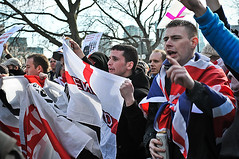
EDL march in support of Geert Wilders 05.03.10Image by belkus via Flickr


Anders Breivik, the alleged perpetrator of Norway's first domestic terror attack and worst act of violence since the second world war, is being widely described across the media as a "Christian fundamentalist" and a "conservative". Initial speculation by The Sun newspaper, the Daily Mail and CBS that the terror attacks were the work of al-Qaeda affiliates was it seems (not for the first time) a premature conclusion.

As a committed Christian myself, it is always distressing to hear the word "Christian" and "terrorism" appearing in the same sentence. I imagine the vast majority of Muslims can relate to that feeling.

So painful is it to consider the possibility that a professed follower of Christ could willfully arm himself with firearms and fertilizer bombs and, in a calculating fashion deliberately murder scores of innocent people, that it is understandable why some fellow-Christians will instinctively respond to recent events by saying, "He was not a real Christian." Indeed, many people who are not Christians would tend to instinctively come to the same conclusion. 

Such a knee-jerk reaction is understandable. Rightly so, we want to draw a sharp distinction between the murdering fanatic and the peaceable majority, who overwhelmingly reject and abhor the acts of destruction carried out by an apparently lone individual in the name of extremist politicised religion.

Rise of "Christian" Nationalism

Beyond these attempts at distancing themselves from the terrorists, however, European Christians have been reminded through Breivik's outrage of the theological and political challenge, perhaps hitherto ignored, of the rise of the heresy of extreme "Christian" nationalism.

Although there are parallels between this pan-European movement and similar white supremacist movements in the United States (epitomised by the Ku Klux Klan), the roots and manifestation of these two strands are sufficiently distinct to warrant separate investigation. For the purpose of this article, I will focus on the European dimension to the rise in the heresy of ultra-right "Christian" nationalism.


Anders Breivik himself states (in the file-sharing site document.no, to which he has been a regular contributor): 

"I myself am a Protestant and baptized/confirmed to me by my own free will when I was 15. But today's Protestant church is a joke. Priests in jeans who march for Palestine and churches that look like minimalist shopping centres.... The only thing that can save the Protestant church is to go back to basics." 

Andres Breivik's call for church reform illustrates the insidious nature of this heresy: like all false teachings, it clothes itself in language and themes that will resonate with some in the mainstream churches who would never endorse the actions of Norway's worst mass murderer. Like all heretics, the false prophet Anders Breivik espouses a doctrine which contains some common ground with large swathes of mainstream Christian opinion.

This superficial similarity of one aspect of his ideology should not obscure the fact that the rest of his doctrine is completely at odds with the teaching of the Bible and with the mainstream of historic and modern Christian teaching and practice.

Right-Wing Critique

His views share common ground with others on the political right who are critical of multi-culturalism, large scale non-European immigration and what they see as a Marxist-based cultural critique of western history and institutions. Although not terrorists, these themes are discernible in the work of such conservative writers as Bruce Bawer, Melanie Phillips, Mark Steyn, Geert Wilders, Theodore Dalrymple, and Robert Spencer. Some include in their critique the specific idea that Muslims, multi-culturalists, supporters of the European Union and social democrats are part of a plot to undermine Europe’s Christian civilization.

Christians in this respect are at particular risk of being roped into this extremist narrative, in the same way that many within the German churches fell prey to Nazi ideology in the 1930s, or who at least failed to offer a robust theological and political critique of it. Christians should note with concern, for instance, the willingness of some on the far right to employ Christian themes, symbols and  narratives in their search for political influence. It is as bizarre as it disturbing that  the Church of England General Synod found it necessary in 2009 to explicitly ban membership of the BNP on the part of its clergy. 

Secretive

As an aside, it is worth noting that, like Hitler, whose "final solution to the Jewish question" was not central to his public policy at first, the Breivik brand of "Christian" nationalism does not make explicit (until now) the true nature of its doctrines of Nordic and Aryan racial purity which underpin its critique of multi-culturalism.

Elsewhere on Document.no, for instance, Breivik notes that he adheres to the Vienna School of thought on cultural conservatism - which he summarises as avoiding the advocacy of racist-based politics, but achieving the same outcome by emphasising that islamisation and multi-culturalism are themselves racist. In approaching public policy in this duplicitous manner,  Breivik demonstrates the traits of cult leaders through the centuries who have not been explicit and public about their doctrine, but who have only expressed their views openly once they have established power. 

In this vein, Breivik commends the tactics of Geert Wilders whose Party for Freedom emerged as the third-largest in the Dutch Parliament in last year's national elections. Breivik also commends joining the anti-islamic group Stop the Islamisation of Europe (SIOE) and is impressed by the tactics of the English Defence League who he says, have gained political ground by highlighting the alleged racist nature of multiculturalism rather than by espousing an explicit doctrine of white supremacy. Breivik states his three priorities for the conservative nationalist cause in Norway as being the creation of a conservative national newspaper, the control of non-governmental organisations in receipt of state funding and, finally, the establishment of a political party equivalent to the EDL.

The Idea of Christendom

European Christian Nationalism rests upon a toxic mix of beliefs and ideology. At its heart is the Roman Catholic, and later Protestant, idea of Christendom. This is the idea that a nation state, or an empire, can be "Christian". It includes the idea of an official state church (whether Roman Catholic as in the case of southern Europe, Lutheran as in much of Scandanavia, or Anglican as in the UK). The idea has its roots ultimately in the supposed conversion of the Emperor Constantine in the early fourth century and the Edict of Thessaloniki 70 years later which made Christianity not only legal, but the only permitted religion of the Empire.

The church's transition in less than a century from persecuted to persecutor is well expressed in the text of the Edict:
“According to the apostolic teaching and the doctrine of the Gospel, let us believe in the one deity of the Father, the Son and the Holy Spirit, in equal majesty and in a holy Trinity. We authorize the followers of this law to assume the title of Catholic Christians; but as for the others .... they will suffer in the first place the chastisement of the divine condemnation and in the second the punishment of our authority which in accordance with the will of Heaven we shall decide to inflict.”

Although the church and the state were understood as having separate functions within the life of the nation or empire, in practice, the presence of an "official" religion through the medieval and modern period in many western European countries has resulted in the creation of a mindset that equates the one with the other. Even today, in an increasingly secular continent, many millions of citizens will describe themselves by default as belonging to the official state-sanctioned church. To be British is still mistakenly seen by millions as to be Christian.

Confusion, Nominalism and Persecution

As well as contributing hugely to nominalism within the church, such a confusion between the nation state and the church has also historically had a devastating effect on the nations that adhere to it, as well as to their neighbours. The violent expulsion of England's small Jewish community during the reign of Edward I in 1290, for instance, was one of numerous acts of of anti-semitism carried out in the name of Christianity in medieval and modern Europe. The Crusades has a similar theological underpinning.

In the post 9-11 age, the resurgent idea of European Christendom has Islam rather than Judaism in its sights. To be "anti-immigration" in modern Europe is code for being "anti-Muslim immigration."


Brevik's conservative doctrines bear out this view. The manifesto 2083: a European Declaration of Independence was published online on the day of the attacks in Norway and is being claimed as the work of Breivik, written in English under the name Andrew Berwick.  Even if this proves not to be the case, its content is relevant to the discussion on the characteristics of Europe's right-wing extremists. The document is heavily focused on anti-Muslim rhetoric, with over 900 references in its pages, the vast majority pejorative.

Included in the Declaration's critique of multiculturalism, Marxism and Islam is a complaint about the rise of liberal approaches to the Bible in European universities, describing undergraduate courses such as "The Bible as Literature" as a "course designed to denigrate the Bible as cleverly crafted fiction instead of God's truth."

It is common for theologically conservative Christians to express similar concerns about the denigration of the Bible, a fact which  makes the Breivik/Berwick heresy particularly insidious, by mixing falsehood alongside truth in a seamless whole.

The Deception of Common Ground

This appearance of common ground between the extreme right and conservative elements within the churches can be reinforced by a narrative that portrays Christians as increasingly victims of secular policies and laws (such as those promoting gay rights) that are increasingly discriminatory to Christians. In such a charged environment, a simplistic narrative that links individual rulings at employment tribunals with a meta-narrative of a Muslim-Marxist-multi-cultural takeover of Europe are as insidious and harmful as they are appealing to some who are already pre-disposed to a conservative mindset.

As Simon Barrow of think tank Ekklesia notes, Christians must urgently respond to these trends by acknowledging, addressing and combating,

"the sometimes disturbing links in our midst between ideological 'Christianism' (as I think it deserves to be called), anti-foreigner nationalism, and the growth of a sometimes naive and sometimes malevolent 'Christianophobia' narrative. The latter can be seen emerging as talk of 'Christian persecution' within Britain. It is part of a fearful, defensive response to the growth of socio-cultural diversity in Western societies, and to the corresponding demise of a 'Christendom' culture that privileged one kind of civic religion."

The Alternative to Christendom
     
In his ground-breaking book The Reformers and Their Stepchildren , Leonard Verduin sets forth a very different approach to Christendom to that advocated by the new nationalists. The "stepchildren" of the sixteenth-century Reformation were the radical groups which not only held to a Protestant understanding of justification by faith, but who at the same time rejected the idea of a state church and of Christendom itself. In the understanding of these believers, the nation-state is, by definition, a religiously mixed entity. Although rulers throughout history have often found it expedient to adopt and promote an "official religion" held by all their subjects, Verduin shows how the radical reformers (anabaptists and independents) insisted that societies are religiously pluralistic. All they sought was the freedom to gather, preach and worship according to their consciences, without the support or the interference of state regulations, law courts or fines for the non-conformist.

The fact that many of these "third-stream" believers were themselves persecuted by both Catholic and Protestant church and secular rulers during the Reformation era highlights the essential difference between their understanding of the relationship between church and state and that of their Constantinian opponents. The model of the separation of church and state was to find its ultimate expression in the Constitution of the United States some 300 years later.

The German  Experience

More recently, the clarity and courage of the so-called "confessing church" of 1930s Germany provies another alternative to Christendom. Under the leadership of Karl Barth, Dietrich Bonhoeffer and Martin Niemoller the "confessors" separated from the official state-sanctioned Protestant church and protested its nazification of Christianity under the influence of Hitler's religious affairs minister Ludwig Muller. 

As Phil Wood notes:

"Christianity makes a poor civil religion.  Allegedly it 'enfeebled' a people.  The Nazis believed this, hence the attraction of Alfred Rosenburg's 'Positive Christianity'.  Rosenburg attempted to rid the Bible of its Jewish heritage and claimed the 'Aryanhood' of Christ.  His influence can still be traced in today's far-right groups, which espouse either outright paganism or a tractable and bastardized Christianity." 

European Protestants today should take a cautionary note of the fact that it was the writings of the much-admired German-born Martin Luther (particularly the 400th anniversary of his 95 thesis) that were used as a springboard by extremists to promote the "German Christian" (ie, Nazified) movement in the years following WWI.

Urgent Work

It is interesting to note that when Muslim-backed acts of terror take place, they are routinely described in the west as expressions of global jihad. When equally atrocious acts take place by non-Muslim white westerners, they are described as acts of deranged madmen. Such a convenient explanation  has been blown apart in the carnage of the Norway killings. Christians across Europe, not to mention the wider societies they belong to, need to wake up to the heresy that needs confronting. and embark more vigorously on that uncomfortable and urgent work. 


If you enjoyed this post, get free updates by email or RSS.
Enhanced by Zemanta

Friday, June 10, 2011

Kulp dormitory and Adelphian fountainImage via Wikipedia


The directors of Goshen College, a Mennonite liberal arts institution in the United States, have reversed its 2010 decision to play an instrumental version of the US national anthem before athletic events.

The decision has been welcomed by the large number of Christians, both in the United States and internationally, who opposed the original decision - on the grounds that the Mennonite peace tradition and theological commitments are incompatible with nationalism and militarism.

Full story.


If you enjoyed this post, get free updates by email or RSS.
Enhanced by Zemanta

Thursday, May 19, 2011

The Changing Nature of Church Membership


Interesting article from The Christian Century on the changing nature of church membership in America.


Many articles on this theme tend to be of the "isn't-it-terrible-how-consumerist-we've-all-become-and-why-can't you-be-more-committed" type.


The above article avoids that easy narrative and looks instead at some historical and sociological models that question whether the emphasis on local churches as "belonging institutions" is the only valid model.


If you enjoyed this post, get free updates by email or RSS.

Enhanced by Zemanta

Monday, January 17, 2011

Publishing Projects


I have started 2011 with the intention of creating a number of self-published written works, to supplement this blog and others that I maintain.

My two main publishing projects for this year are:

1. A series of essays under the working title of Understanding the Times: Essays in Christian Engagement

2. A book examining the radical Christian history of Bristol, my home town.


The series of essays arise from the same root motivation as this blog - namely to relate the Christian faith to the real world of politics, economics and culture.  They will hopefully be of interest to people of all faiths and none. 

The essays will  be published once a month on the You Publish site and will be available to download as PDF documents.

In fact, the first essay, setting the scene and introducing the theme, has been uploaded already and can be read here.

Comments welcome, as always. 

The image is Ship of Fools by Hieronymus Bosch, and forms the front cover of the first essay.


If you enjoyed this post, get free updates by email or RSS.
Enhanced by Zemanta

Thursday, September 02, 2010

Give Me That Old Time Sectarian Religion

Sketch of Søren Kierkegaard. Based on a sketch...Image via Wikipedia


Whatever of true Christianity is to be found in the course of the centuries must be found
in the sects and their like.


Søren Kierkegaard


Enhanced by Zemanta

Monday, July 19, 2010

Burka Banning: a Christian Perspective


After an initial appearance in the Belgian legislature (a nation not known for its large number of fully-veiled Muslim women, as far as I was aware), the issue of banning burkas in public has moved to the French parliament and is also now receiving attention among Spanish politicians.
It was therefore only a matter of time before the issue would be raised in the British context.

Philip Hollobone, Conservative MP for Kettering, has provided the opportunity with his pledge to introduce a private member's bill which would ban the Muslim facial veil in public - along with the wearing of full-face balaclavas.


It's worth stating at the outset that the actual issue is over the niqab, the full veil which allows the eyes to be seen. The burka - which hides the eyes behind a mesh - is almost never seen outside of Afghanistan or parts of rural Pakistan.


It seems unlikely that a bill to ban the burka/niqab/balaclava would ever make it to the House of Commons - especially in the light of Immigration Minister Damien Green describing such a ban as "un-British". The issue, however, is one that warrants thoughtful consideration as it touches on a number of important issues of personal freedoms, the role of the state, the equality of women and the place of religion in a modern society.

Advocates tend to cite four main reasons in favour of such a ban:

a) the burka/niqab is a symbol of the oppression of women. Removing it from the public space is an emancipating and empowering act for women

b) the veil hinders communication and, therefore, tends towards segregating the wearer from the wider non-veil wearing society

c) the garment is dangerous to the wearer in certain settings - such as near machinery

d) the garment can be a security risk. Labour MP Stephen Timms was recently stabbed at his constituency offices by a woman wearing a burka-like garment. At least one terror suspect in Britain has attempted to avoid arrest by dressing as a Muslim woman.


There is a fifth reason why some desire such a ban, though it is rarely stated in public debates. This is to limit the perceived spread of Islam in the west by reducing aspects of its visible presence.


Those seeking to apply a Christian perspective to the issue might do well to consider the following factors.

1. A garment similar to the niqab was common among women in the Bible

Especially in the Old Testament, the veil was often worn, for cultural, family and ethical reasons.
The matriarch Rebekah clearly wore one as did the "beloved" in the Song of Songs. The story of Tamar reveals that the veil could, as today, be used for deceptive purposes. In Isaiah's day, it appears that veils were part of the essential wardrobe of the fashion-conscious Jerusalem urban elite.


2. The focus needs to be on the specific question of a legal ban

The current debate does not centre on whether the veil (or balaclava) is appropriate or liked, but whether it should be made illegal in public. A wider debate about the meanings inherent in the niqab may well be worth having, but the more limited issue that the current wave of European legislation raises is whether the state should criminalise the wearing of such a garment in public.


3. A simplistic secular, feminist analysis of the issue should be treated with caution

As my friend Steve Smith has pointed out, the current debate often rests on a binary assumption that veil = subjugation, and non-veil = liberty. Clearly, many women in liberal western democracies do have a number of freedoms not always afforded in other parts of the world. Having said this, western women do face significant levels of oppression from men, some legalised.

Writing in the Washington Post, American feminist writer Carol Campbell has noted what she perceives as one such area of oppression:

For many American women, the feminism that once attracted them with its lofty goal of promoting respect for women's dignity has morphed into something antithetical to that dignity: a movement that equates a woman's liberation with her license to kill her unborn child ... and colludes with a sexist culture eager to convince a woman in crisis that dealing with her unplanned pregnancy is her choice and, therefore, her problem.

Indeed, it is a conscious rejection of western liberalism, and, its perceived destructive influence on the family unit, that is currently providing one of the motivations for some women to explore more conservative religious movements. The language of women being "precious" and requiring "protection" in Islam may be repellent to many secular feminists but to some, the security that such a world offers is an attractive option if the alternative appears to be a life of insecure short-term relationships, casual sexual encounters and divorce or abandonment in one's middle years.


4. The bigger question about the nature and role of government should be addressed

Although there has been a minority view among Christians over the centuries that human governments have no genuine authority at all to coerce obedience - Leo Tolstoy, Dorothy Day and Jacques Ellul are among those often associated with this strand of Christian Anarchism - the vast majority of Christian thinkers and churches, Protestant and Catholic, have accepted the traditional view that the state is a God-given institution with legitimate legislative and punitive powers. For the purpose of this article, I am assuming this majority Christian position on the role of government.

Within this mainstream framework, much attention has been given to Romans chapter 13 where the role of government is stated by the apostle Paul as being to "commend good" and "punish wrongdoing". John Stott once noted that governments of all types tend to perform the latter role much more effectively than they do the former! Nonetheless, this framework suggests that governments do well to consider the specific moral issues involved before criminalising any action.

At this point, a call to ban the burka in public seems to fall short. There is no breaking of a moral code when a woman wears such a garment (as would be the case, for instance, if she were to appear in the high street naked). No harm is being done to another person. There is no victim to be protected. Claims that the woman herself is a victim require too subjective a judgement on the motivations and meanings inherent in such attire to be a valid basis for legislation, in my opinion.


In the absence of such a clear moral issue, our default position should surely be to allow human beings to exercise their own choices and freedoms in public (and private) without interference by the state.


5. We should not abandon informal means of achieving desired outcomes

Our recent political history in the UK has tended to create the assumption that the majority of social issues can be addressed through legislation. This can actually amount to a diminishing of the value of more personal, informal means of effecting positive social change or of resolving difficulties. The
general point is to consider carefully whether we want the state to take on the role of clothes monitor when other more effective mechanisms exist.

Jack Straw, for instance, asks veiled women to remove their veils when he meets with them at his constituency surgeries in Blackburn, so that he can better hear and understand what they are seeking to communicate with him. His experience, apparently, is that about half of women comply with this request and half do not.

Philip Hollobone, by contrast, is quoted as saying that he would refuse to meet a woman if she declined such a request. This position seems unnecessarily illiberal and against the spirit of the role of a public servant, whereas Jack Straw's approach seems more reasonable and pragmatic.

Health and safety aspects of robe wearing can (and should in my opinion) be dealt with at the level of the individual organisation or business concerned. There are situations where such attire is unsafe - best practice in hygiene requires a surgeon to prepare for and perform an operation with bare arms, for instance. This does not require legislation. Former Bishop of Rochester Michael Nazir -Ali, the son of a convert from Islam, has noted that such issues can be dealt with at a decentralised level.


5. We should support those actions which lead to social peace

Although unwavering on key issues, the apostle Paul's approach to life in a multicultural society (the urban Roman Empire) was notably peaceable and accommodating, while always keeping his focus on the furtherance of the Christian message. Although he was not involved in a democratic society, his mindset can be applied to those of us living in one:


So whether you eat or drink or whatever you do, do it all for the glory of God.

Do not cause anyone to stumble, whether Jews, Greeks or the church of God — even as I try to please everybody in every way. For I am not seeking my own good but the good of many, so that they may be saved.

1 Cor 10:31-33


Elsewhere, Christians are warned against those who have "an unhealthy interest in controversy." Of course there are times when a principled stand needs to be taken on issues of clear right and wrong, such as matters of justice. We must not fall into the trap, however, of assuming that all issues are in this category.

There is anecdotal evidence to suggest that the politicising of the issue of burka wearing tends to inflame inter-communal passions rather than reduce them. France has already had its first "burka rage" incident, for instance when a female lawyer (no less) ripped the veil from a fellow shopper in a department store. Police in Leicestershire are also concerned at a discernible rise in recent months in such physical or verbal attacks on women wearing veils.

In summary, we would do well to highlight and overcome any perceived fears of "the other" that may be behind calls for the banning of the veil and affirm that, despite its difficulties, freedom of expression is a commodity worth preserving. Maintaining such freedoms is significantly easier than regaining them once lost.


Image, Steve Evans.


If you enjoyed this post, get free updates by email or RSS.

Thursday, July 01, 2010

Al Qaeda Launches English Language Magazine?

No-one seems to have read it, but numerous news services are reporting this week the creation of a new English-language online magazine by Al-Qaeda in the Arabian Peninsula, based in Yemen.

Max Fisher at The Atlantic gives five solid reasons why he thinks it might be a fabrication.

In the meantime, the alleged magazine - named Inspire - shares its title with a Worthing-based Christian magazine with a monthly readership of 200,000.

Now there's an irony.


If you enjoyed this post, get free updates by email or RSS.

Saturday, June 26, 2010

Saturday, June 05, 2010

A Christian Perspective on Prisons: Interview with Stan Moody

The following article is reproduced from Truthout under an Attribution Noncommercial 3.0 Creative Commons Licence.


Stan Moody has served in the Maine State House of Representatives both as a Republican and a Democrat, pastors a small country church in Central Maine and served as a chaplain at the maximum security Maine State Prison, where he ministered to inmates in the Supermax unit. He has authored several books on the state of the evangelical church in America, including "No Turning Back: Journal of an All-American Sinner," "Crisis in Evangelical Scholarship: A New Look at the Second Coming of Christ" and "McChurched: 300 Million Served and Still Hungry."

Moody has written several recent articles focusing on prison issues, including "A Suspicious (and Lonely) Death in Maine State Prison's Lockdown Unit," "At Angola Prison, Does Jesus Christ Save?," and "Maine's New Capital Punishment Law: Solitary Confinement."

Angola 3 News: The Bible uses the word "prison" 116 times, and Psalm 69:33 reads, "... the LORD heareth the poor, and despiseth not his prisoners." Throughout the Bible, prison and executions are identified as tools of oppression against the underclass and dissidents, including the early Apostles and Jesus himself. The Bible presents the liberation of prisoners as a social good, as illustrated by the following noteworthy passages:

  • "Which executeth judgment for the oppressed: which giveth food to the hungry. The LORD looseth the prisoners." (Psalm 146:7)
  • "I the LORD have called thee in righteousness ... to bring out the prisoners from the prison, and them that sit in darkness out of the prison house." (Isaiah 42:6-7)
  • "The Spirit of the Lord GOD is upon me; because the LORD hath anointed me ... to proclaim liberty to the captives, and the opening of the prison to them that are bound." (Isaiah 61:1).

US popular culture often proudly makes reference to the Judeo-Christian traditions so prominent in US history, yet "Get tough on crime," is still the winning political slogan of the day. How did society come to view incarceration as a social good, as something necessary to keep society safe?

Stan Moody: First, we have ghettoized ourselves into white, suburban group-think that builds on self-righteousness. We are probably the most self-righteous nation on earth, which precludes us from contemplating, "There but for the grace of God, go I." Tragically, the greatest social good in America has become the acquisition of wealth through "legitimate" means, such as self promotion and corporate empire building, where greed becomes an acceptable virtue. Those who take shortcuts to the American Dream are pariahs to be banished from the kingdom of us pedestrian wannabes who, in frustration, quietly cheat on our taxes and on our spouses.

Jesus makes it clear that His followers are to love their enemies, do good to those who hate them, leave vengeance and retribution up to God and visit Him in prison. "Inasmuch as you have or have not done it to the least of these my brothers, you have or have not done it to me."

A cursory examination of our nation's history will satisfy that the founders had no Christian theocracy in mind and, in fact, crafted a document that expressly ensured otherwise. Yet, people who advocate for the theocratic view are not listening. The best evidence that we are not a Christian nation is not in the actions of government but in the actions of our erstwhile evangelical state church that has embraced the Republican Party as God's instrument for redemption. The vehicle for that redemption is a moral code rather than divine grace. Getting tough on crime is just another version of an anti-Christian moral code.

A3N: Why do you suppose prisons and prisoners' living conditions are so far removed from the popular US consciousness today? How do US popular culture and the corporate media present the issue of human rights in prison?

SM: Very simply, as the nation with by far the highest incarceration rate in the world, neither the public nor the mainstream news media wants to know anything about prisons. Prisons are the depositories of our social programming and education failures. "Get them out of our sight." The ultimate driver is cost. Only as the public becomes aware of the enormous cost of the revolving door of incarceration will they begin to pay attention to what is going on inside and how we might change the dynamic. Corrections has taken full advantage of this denial by essentially saying, "You cannot possibly understand what we are up against." They have built incarceration into a growth industry that is sapping our national strength and shredding our decency.

There is a shroud of secrecy that envelops prisons. That shroud of secrecy is protected through a system of nepotism, patronage, and public ignorance and apathy. The public thinks of prisons as country clubs, while they are, in fact, crushingly boring places within high-tech boxes designed more for mass movement than rehabilitation. The human element has tragically been removed from most US prisons by a public frustrated in pursuit of its own dreams, thereby advocating for crushing the spirits of those getting what they enviously consider to be a "free ride."

Both the mainstream press and the public it entertains are too pedestrian for relevancy in this volatile world in which we live.

A3N: How can people of faith shed light on human rights abuses in prisons?

SM: The best answer is to challenge the comfort zones of your denomination, the media, your friends and neighbors and your political leaders. Write, speak and live out your faith on the front lines of activism for human dignity, especially when it disturbs your comfort zone. Only through patient suffering can you convince others of the legitimacy of your beliefs.

Belief in the power of God to move mountains by touching one life will drive people of faith toward little victories, knowing they are cumulative. While Christian volunteers in prisons are legion, they scatter to the four winds when the subject of human rights is raised. As a Chaplain at Maine State Prison, I sometimes was criticized by management for not sticking to "Chaplain things," meaning administrative and counseling duties. There was hardly a single volunteer who joined with me once I stood up for Sheldon Weinstein, who died of a ruptured spleen in segregation on April 24, 2009, a couple of hours after I requested a roll of toilet paper for him. He had been using his pillow case; he had no pillow anyway.

I speak as a Christian, believing that the willingness to sacrifice one's own comforts in defense of the human rights of those in exile among us is the best barometer of the legitimacy of faith. "Touching a life" rarely brings press coverage, but it may well reap huge rewards in the grand scheme to which people of faith must demonstrate devotion.

We must take great care, however, not to be caught up in embellished stories. If we recognize our own need for redemption, we will see the whole person rather than his or her crime.

A3N: The Bible also makes several references to the persecution of the early Christians through physical torture and forced labor (II Corinthians 11:23), and solitary confinement (Acts 28:16). Quakers and other faith-based prison reformers developed Pennsylvania's Eastern State Penitentiary, self-avowedly "one of the most expensive and most copied buildings in the young United States ... as part of a controversial movement to change the behavior of inmates through 'confinement in solitude with labor'." This model was soon replicated nationwide.

Today, do you think that the practices of forced prison labor (recognized as legal slavery by the 13th Amendment of the US Constitution) and solitary confinement have any beneficial effects on the spiritual growth of people in prison? How has your outlook on this question been influenced by what you witnessed first-hand, working as a chaplain at Maine's maximum security state prison?

SM: Dehumanization is the most debilitating punishment that can be imposed on another human being. Prisoners are no exception. I can imagine a situation where prisoners are used for the crudest labor but are valued as human beings - treated fairly and consistently. On the other hand, I can imagine another situation where you have numbers of entrepreneurs in a prison who are making very good money but are working under conditions of arbitrary patronage and favoritism. Slavery does not always have to do with how much money you make. It may be possible to learn something of the value of human life even in the harshest of conditions.

I found at Maine State Prison that the biggest impediment to spiritual growth was idleness and lack of respect in work, in life and in interrelationships. Earn the right to clean the toilets, if you will, or to pick cotton, or to work in the kitchen, but know that you are respected for earning that right and will be respected for the kind of job you do and not because you are somebody's "kid." Know that you are valued as a human being and that the administration is always looking for a spark of hope to kindle.

I am reading "In The Place of Justice" by Wilbert Rideau. It is interesting that the cotton picking "slavery" at Angola seems to get far less space than the sexual slavery that stays beneath the radar of the administration and destroys human dignity.

A3N: The Maine State Legislature recently passed a bill that focused on the use of solitary confinement in Maine's prisons. Initially, the bill sought to limit the use of solitary confinement, but The Free Press has reported that it was "seriously amended" to only call for more scrutiny of how solitary confinement is used. What do you think will be the impact of the bill?

SM: As a former Maine State Legislator, I was very involved with this bill and was the only former prison staff member to give testimony. The Committee ignored our plea for transparency and accountability and, instead, continued its blind, loyal support of the Department of Corrections, the very institution it has been entrusted to oversee.

It is incorrect to view this bill as having been "seriously amended." The bill was killed with kindness by turning it into a resolve for the Department to study itself. A resolve is what a legislative committee does to kill a bill when it fears public uprising if it votes "ought not to pass." Legislative resolves are akin to patents with claims so narrow that you would not infringe on them if you copied the design but changed the color. They are not worth the paper they are written on.

Sadly for this case, the resolve showed a failure of courage on the part of committee members on both sides of the aisle. The House and Senate chairs failed their constituents and the State of Maine.

The good news is that with the upcoming legislative session to begin in January, 2011, and with the election of a new Governor, there will be a bevy of new prison bills to debate. I have personally spoken to 6 gubernatorial candidates about the conditions at the Department of Corrections and the Maine prison system and expect that the next Governor will be far better informed than previously. Further good news is that the prison administration immediately began to implement some of the advances contained in the bill. This, after having expended their energies defending their previous policies, indicates that they are aware of the battle ahead.

Prisoners who "were not supposed to be there" were put back into population. Solitary confinement residents can now earn privileges such as up to 4 hours daily outside their cells, normal prison garb instead of orange jump suits, TV's and radios, and contact visits. Sadly, there has not yet been a disposition with regard to those mentally ill prisoners held in solitary.

A3N: From the perspective of someone who has worked inside a prison as well as in the Maine State House of Representatives, why do you think that a stronger version of the bill was unable to be passed? Why did government officials and prison authorities oppose it?

SM: Corrections administrators in Maine have successfully sold the public on the falsehood that nobody understands what they are up against. From the Commissioner on down, with occasional exceptions, you have people who have come up through the guard system rather than professionals trained to be innovative in solving the larger problem of the waste of human life. The Governor and legislative committee members, convinced that they did not understand people convicted of crimes, consistently bowed to the wisdom of the "old boy network."

I recently intervened in a law suit by a former guard against the State of Maine for the purpose of unsealing a deposition that offers a damning picture of the inside politics of Maine State Prison. I was successful in doing so and have studied it in its entirety. The closest I can come to describing it is that it ought to be subject to a RICO (federal racketeering) investigation. Over the next week or so, I expect to issue a public report. It is a fear-based culture that adheres to secrecy at the expense of both staff and prisoners. While there is very little skill in managing people, what distinguishes prison management the most and is most endearing to politicians is the ability to circle the wagons to put out fires.

The legislative committee of oversight has become an echo chamber for the Department of Corrections. It exhibits the height of denial and laziness to fail to listen to professionals who have put their personal reputations on the line in the pursuit of truth. Why would they listen to such people when it is their pattern of behavior to sacrifice their own integrity in the pursuit of political gain?

We are not done ... This bill was the best thing to come along for prison reform in the history of the State for it showed the Department as the tired old system it is - a 19th Century culture housed in a 21st Century box. We will prevail, God willing, and we will see a day when our Corrections house is cleaned from top to bottom.

A3N: Any closing thoughts?

SM: The Eastern State Penitentiary was torn down, I believe, in 1973 ... Most of the prisons in the US today, however, retain the Eastern State, 19th Century Quaker culture that punishment builds character. It has survived through a system of patronage and nepotism - getting rid of good staff people in favor of the corrupt. The high tech boxes that we today call prisons are designed to manage mass movement rather than to build community and self respect, with punishment being arbitrary, inconsistent and capricious in most cases, extended out of sheer boredom.

Prison staff believes and promotes the belief that they have dangerous jobs ... I ran some statistics on jobs in the US ... Prison guards hardly surface ... At the top are commercial fishing and logging industries, both prominent in Maine but rarely heard to complain about danger ... It might interest the readers to know that a prison guard has a lower death rate than do licensed drivers - lower than 21 per 100,000 population.

Studies prove that re-entry programs begun in the inside and carried over to the outside will cut recidivism rates by as much as 75%. Why, then, are we not implementing those programs? I believe it is because Corrections is protecting itself as a growth industry. It is only when the public begins to realize it is being fleeced, will it demand change. Meanwhile, we the people continue to elect arrogant obstructionists to public office in protection of the status quo.


If you enjoyed this post, get free updates by email or RSS.