Showing posts with label media. Show all posts

Monday, June 27, 2016

Brexit and the Rise of Poor Loser Syndrome


It's interesting to think about the reasons for the rise in "Poor Loser Syndrome which has been so clearly manifest since Friday morning's announcement that a majority of British voters had chosen to leave the European Union. 


I can't help thinking about the different ways in popular culture that winning and losing is currently framed. In some sports, especially those with a large TV audience, the concept of losing (especially a cup final or league title) has become massively inflated - both in emotional and financial terms.


If we were to view videos of the final minutes of FA cup finals from the 1950s to the present day, I suspect that, along with the improved production qualities, we would also see an increase in the severity of emotion expressed by losing teams.


The media have played a part in encouraging this mindset of over-reaction (since it has a popular entertainment value). as has the presence of big money into some sports, which has the capacity to induce strange and unseemly behaviour in otherwise stable and moderate people.


This drift towards the "awful-isation of losing" can also be seen in popular television game shows such as Million Pound Drop, where the failure to win large sums of money is framed - for entertainment purposes - as an unmitigated disaster.


Behind these trends is a growing idolatrous attitude towards money and power. The rise of grievance politics, in which the perceived failure of the individual to achieve personal political self-actualisation is presented as the lowest form of human oppression, adds to the toxic mix.


It seems rather prosaic, but perhaps a simple but significant contribution that many people could make to what Thomas Aquinas described as The Common Good is to simply express publicly the dignified habit of losing well.


If you enjoyed this post, get free updates by email or RSS.

Friday, September 25, 2015

The Hajj Tragedy, Victim Blaming and the Gospel of the Kingdom

Of the many tragedies our world has suffered in 2015, the death of over 700 pilgrims at the annual Hajj in Saudi Arabia must be one of the most pitiful. The idea of hundreds of devout worshippers, having saved their hard-earned money to pay for this once-in-a-lifetime event, being crushed to death at a time which should have been at the pinnacle of their religious faith journey, is a true tragedy.
  
Along with the death of thousands of migrants in the Mediterranean this summer, and the desperate experience of those affected by the Ebola outbreak in recent years in west Africa, the Hajj calamity is a human tragedy on a grand scale.

With tragedies come recriminations. Reports suggest that some Hajj pilgrims are blaming the Saudi police and authorities for the stampede in Mina. Saudi spokesmen, meanwhile, are reported as blaming African pilgrims for not following instructions. Iran is blaming the Saudi Royal Family.  

When faced with a tragedy in his own lifetime, the mainstream view confronting Jesus of Nazareth appeared to be that the victims themselves were to blame for what happened.  Jesus responded to this popular assumption by analysing the self-righteous motives of his contemporaries who were not directly affected by the tragedy, and turned their complacency upon themselves by warning them of their own impending doom. 


"Or those eighteen who died when the tower in Siloam fell on them—do you think they were more guilty than all the others living in Jerusalem? I tell you, no! But unless you repent, you too will all perish.” (Luke 13:4)


Although fewer in number, the victims of the Siloam rower collapse were also the objects of criticism by the self-righteous of Jesus' day. The world-view of the critics is not difficult to detect: a high view of God's sovereignty, meaning that all that happens does so ultimately by the permissive or directive will of God, and a covenant theology which saw unfaithfulness to God resulting in judgement, combined to interpret the death of these 18 as the result of their morally dubious state.

Victim blaming today seeps through much of the analysis of contemporary human tragedies. It is implicit in the European Union's decision in 2014 to not support Italy's Mare Nostrum operation, rescuing migrants in the Mediterranean. The claim was that such a humanitarian initiative would act as a "pull factor" in emboldening migrants to board unseaworthy vessels and attempt the perilous crossing from the north African coat to Italy or Malta.  Victim blaming was present in the Sun newspaper's coverage of the Hillsborough tragedy - an editorial decision for which it has publicly apologised. 

The focus of Jesus' few words on this Siloam tragedy is not on explaining "the problem of evil" in abstract, philosophical terms. Nor does he align himself with those who cast aspersions upon the victims. Instead, he turns the tables and points to those of us who would pass judgement:


"Unless you repent, you too will all perish."


It is highly unlikely that the words of Jesus were intended to predict further tower collapses or similar calamities. Rather, his focus is on something much worse.

To "perish", in its New Testament usage , often means to come under the judgement of God - in this age and the one to come. The apostle Paul, for instance, is quite willing to distinguish between "those who are perishing" and "us who are being saved." (1 Corinthians 1:19) and elsewhere describes those who "perish because they refused to love the truth and so be saved." (2 Thessalonians 2:10)

Evidently, the Son of God saw it as imperative that people "repent" of sinful patterns of thought, attitude and action. This theme of repentance is present, implicitly or explicitly, throughout the gospels and other New Testament writings.

The tragedies of the Hajj, of tsunamis and of plagues are not to become opportunities for hard-hearted self-righteousness, but occasions to express sorrow and sympathy with the victims, their families and their communities. They also provide a stark opportunity to examine ourselves by asking some uncomfortable questions: have I repented? Am I to perish?

For those who embark on such a process of self-examination, the words of the gospel truly come as good news:


"For God so loved the world that he gave his one and only Son, that whoever believes in him shall not perish but have eternal life. " (John 3:16-17)


If you enjoyed this post, get free updates by email or RSS.

Tuesday, November 13, 2012

MPs Debate Child Sexual Exploitation

Read - UK Parliament:


At last we are having a debate on child protection and child sexual exploitation. Perhaps that explains why the Press Gallery is deserted. This is not about celebrities, the structural overhaul of the BBC or senior politicians possibly being connected with paedophilia; it is about child sexual exploitation.......

Frankly, the recent media circus with sensationalist celebrity scalp hunting has really undermined the importance and severity of the issue we are at last discussing today. I think that the media should take note of that.


Tim Loughton MP


If you enjoyed this post, get free updates by email or RSS.

Wednesday, October 31, 2012

Hurricane Sandy and the Prophetic Nature of Films

Am I alone in seeing parrells between Hurricane Sandy and the movie The Day After Tomorrow? Recent images of sea water coursing though lower Manhattan compare at least superficially with the scene in the film when a massive wave surges onto the New York island as three storm systems collide over the east coast of North America.

The ability of script writers to imagine future scenarios is, of course, central to their craft. I'm interested, however, in the extent to which such imaginative work draws upon the possibility of scenarios which are both contingently possible while also being sufficiently unusual to fulfil their role as vehicles for fantasy and escapism.

Other examples include

  • the election of a black President in episode one of TV series 24, seven years before Barack Obama's successful election campaign
  • the creation of an all-encompassing television environment in The Truman Show, in anticipation of the Big Brother TV phenomenon
  • two aspects of the film Minority Report seem relevant: one is the use of targeted individualised advertising (in the mall scene) which anticipates the current fusion of data mining with mobile technology to focus personal product promotion; the second is the concept of pre-crime, which perhaps highlights some of the ethical difficulties with entrapment-based models of crime surveillance and prevention in an increasingly autocratic age.
  • the prediction of artificial intelligence in the form of the HAL 9000 super-computer in the 1968 science fiction classic 2001: A Space Odyssey
  • the presence of hand-held tablets and computers in Star Trek episodes as early as the 1960s
    

Cover of "The Truman Show [Blu-ray]"


It was, apparently, in recognition, of the ability of some creative individuals to "see" possible future scenarios that the CIA toyed with the idea of forming collaborative working relationships with Hollywood in an attempt to draw on a different strand of intelligence to complement their more traditional information-gathering techniques. This experiment, however, did not survive the overhaul of the CIA following 9-11.


If you enjoyed this post, get free updates by email or RSS.
Enhanced by Zemanta

Thursday, May 10, 2012

Porn, Morality and the Liberal Dilemma

Morality
Morality (Photo credit: joel duggan)


I got involved briefly this week in a discussion on Liberal Conspiracy on the subject of forcing ISPs to block porn sites. The move has been mooted by the British government this month as part of its "pro family" agenda. (Incidentally, have you ever met a politician who described themselves as anti-family?)

The blog post at Liberal Conspiracy was implicitly against the idea of blocking such sites, but focused more specifically on the fact that it was those pesky Christians again who had been conducting research into the feasibility of such a move. The article's title - The Religious Fanatics Behind the Tory Plan to Block Porn - gives a slight hint of where the author was likely to go on the subject.

In the course of the discussion (299 comments and counting) "pagar" made the following assertion:

"Morality is a matter for the individual, not the collective."


I replied to pagar:

"Really?

Opposition to murder, rape and human trafficking are just three of the behaviours that require a collective morality."


To which pagar answered: 

"No.
These things are legitimately matters for a collective legal system not because they are “immoral”, but because they involve coercion, the imposition of one’s will by compulsion."


Pagar's comment, in my opinion, goes to the heart of the liberal dilemma. On the one hand, s/he wishes to reject the idea of a universal or community-wide morality, replacing it with a radically individualised idea of personal rights. On the other hand, pagar appeals to an implicit universal moral ethic (namely, that it is wrong to use coercion on another) as the reason why law should be enforced against murders and traffickers.

Pagar and others who argue this way may or may not have thought long and hard about "why" they assume that not coercing people is wrong in itself, and therefore the basis for law.(Let's lay to one side for now the fact that all state-sanctioned law involves coercion. Try not paying your tax next year for proof of this reality.)

It may be argued that it is "obvious" that imposing one's will by coercion is "a bad thing". I would strongly agree, but unlike the secular liberal, I am not satisfied with such a subjective answer alone. In the Middle Ages, it was "obvious" that people were born unequal and should be treated differently under the law. In the 18th century it was "obvious" (even to such apparently enlightened figures as Thomas Jefferson) that the "negro" was "innately inferior" to the white man.


Portrait of Thomas Jefferson by Rembrandt Peal...
Portrait of Thomas Jefferson by Rembrandt Peale, 1805. New-York Historical Society. (Photo credit: Wikipedia)

By stating what one regards as "obvious" as the basis for an absolute moral code, imposed by the force of the state, a whole number of miserable and oppressive policies can be and have been imposed.

So, I agree with pagar that coercion of one individual on another is wrong (with the proviso that all law involves coercion). Where I differ from him/her is the denial that such an assumption is an example of a collective morality. Simply put, people's view that it is wrong to kill and rape rests upon a moral assumption which the community must subscribe to in order for the view to find expression in tangible legal rights.

It seems that when humans come together to form societies, they cannot help but establish communal codes of acceptable and unacceptable behaviour. To deny this seems to me to fly in the face of the evidence of history.

Those who deny the need or reality of a communal morality end up, it seems to me, creating one anyway. The commitment to individual rights rests upon a community-wide acceptance that such rights do in fact exist. In effect, communal morality at its best upholds and underpins these rights and freedoms. Denying communal morality seems to me a philosophical and political dead end.

Which, if I'm right, begs the question, "What is the communal morality and where does it come from?"

But that's for another day. 


If you enjoyed this post, get free updates by email or RSS.
Enhanced by Zemanta

Sunday, March 25, 2012

Lamentable Media Coverage and State Deception: the Scandal of NHS Legislation

Speaking at the NHS Confederation Annual confe...Speaking at the NHS Confederation Annual conference and exhibition in Manchester on 8 July 2011 (Photo credit: Wikipedia)


The Health and Social Care Bill has just passed through Parliament. A huge step towards privatising the NHS has been taken. The most cherished of UK public institutions is being dismantled and large private providers are already signing contracts. All this is against the wishes of a large majority of the public and an even larger majority of health-care professionals.

A big question is why did the national news media fail to cover the issue clearly, honestly and accurately? Their failure to hold David Cameron, Andrew Lansley and their colleagues to account, or to adequately represent the views of professionals and the public was, at times, very frustrating. It demonstrates the weakened state the UK news media. If hacking reveals the deficits of tabloid journalism, this failure represents the deficits of ‘serious’ broadsheet newspapers and national broadcasters.

In many respects, one should look to the actions of the political class first. David Cameron had a seven year career in corporate public relations. The Conservative Party went to extremes to manage its image on the NHS, to obscure its true intentions, and used every trick in the media management playbook to do so. The Conservative-led Government went well beyond spin as it regularly and blatantly misled and now misleads the public about the NHS and the bill.

The very weak opposition from the Labour Party and the leaderships of the BMA and many professional bodies added to the problem. The Department of Health had already been infiltrated by McKinseys consultants under New Labour (see Player and Leys, 2011 ↑ ). For most of the last year, Labour was unclear on its own policy direction ↑ and thus was virtually silent. Equally importantly, the leaderships of the BMA and several Royal Colleges, bypassed their memberships and were in active dialogue with the Government. Few initially were prepared to condemn the bill publicly. So, without authoritative and high-profile opposition, why should journalists have been concerned to investigate and cover the large, highly complex details of the bill?

However, these are now chronic problems in political journalism generally. An over-dependency on Westminster sources, and a general unwillingness to cover detailed policy matters, are two important failings of UK news (see Davis, 2010 ↑ ). Far too often, actual legislation is not considered newsworthy enough to report unless there is internal party conflict or scandal attached. There is also a problematic hierarchy for newsgathering that ensures government sources dominate, with the official opposition trailing behind. Far too often other smaller bodies, groups of professionals and the wider public are excluded altogether from the reporting beat. These problems are common across the UK broadsheet press, whether they be from the left (Guardian ↑ ), centre (Independent ↑ , Times ↑ ) or right (Telegraph ↑ , Mail ↑ , Express ↑ ) of the UK political spectrum. They are also too apparent in national news broadcasters including the BBC ↑ .

This was all too apparent for much of 2011. Professional opposition was widespread. Keep Our NHS Public ↑ , 38 Degrees ↑ , Spinwatch ↑ and others began scrutinising the bill and campaigning at an early stage. New local BMA groups sprang up all over the country in an attempt to force their leadership to engage with its ordinary members about their concerns. Numerous articles and blogs appeared, written by health professionals who had scrutinised the bill in far more detail than politicians or journalists[i]. Public meetings took place regularly - and across the UK, not limited to England. Many demonstrations took place. Marathons were run. Barely any of this was reported or drawn upon in the early stages, or appeared in smaller pieces and letters buried within. Opposition stories focused primarily on disgruntled Liberal Democrats.

Under such circumstances, far too often the Government was given too much space to set the reporting agenda and to define the debates themselves. Serious concerns at all levels were ignored until very late. Perhaps the most concerning of these was the Conservative Leadership’s total disregard for democratic institutions and practices. On Andy Coulson’s advice, Lansley and Cameron’s long-term privatisation agenda was completely obscured in opposition and during the election. The headline pitch was about securing the NHS: ‘cutting the deficit not the NHS’ and ‘no more top-down reorganisations’. The plans were not part of the published Coalition Agreement. Lansley’s long term links and dialogue with private health care lobbyists and providers was barely mentioned (see Spinwatch ↑ ). The same went for the part played by McKinseys. It was also clear to all professionals on the ground that many parts of the bill were already being implemented all through 2011. Civil servants repeatedly blocked the publication of their own risk assessments. Why wasn’t this disdain for democratic process challenged in media reporting?

Similarly, lies and misrepresentation were regularly reported on front pages without challenge. The NHS was portrayed as being inefficient and having comparatively poor health outcomes ↑ in comparison to other countries. But much of the evidence used was certainly debatable (see Roy Lilley ↑ ). Cameron and Lansley regularly stated that the majority of doctors supported them ↑ . But, from an early stage polls showed that two thirds of doctors were very concerned and critical. Towards the end it was over 90%.

That GPs were already forming themselves into Clinical Commissioning Groups (CCGs) was promoted as a sign of positive embrace ↑ . But GPs were given no choice as they watched PCTs being dismantled and new funding structures imposed. News coverage continually reported the line that doctors would be in charge of the budget and that this was about doctor empowerment and patient choice. As doctors in the newly formed CCGs have already found out, their influence over the NHS budget is actually more controlled by Whitehall than ever. CCGs are also having to look to private consultancies to take on key management roles. GP power looks like it will be no stronger than
before.

All along, Lansley, Cameron, Clegg ↑ and then Shirley Williams publicly stated there was no privatisation taking place. The word ‘reform’ is the most common description. But, plain and simple, this is a large step towards privatisation. Bupa, currently flooding the UK with advertising, knows this. So do Virgin, Sainsbury’s, United Healthcare, Circle, and Care UK.
What is happening is ‘reactionary’ and ‘regressive’ and threatens to take the UK public health system back to its pre-1945 state. £20 billion of ‘efficiency savings’ are really £20 billion of ‘cuts’. Again and again Government words and phrases have gone unchallenged - until the last months of the bill. When they were, professional association objections, were all too easily discounted as the calls of ‘self-interested unions’. Labour’s challenge, now led more convincingly by Andy Burnham, was dismissed as ‘opportunistic’. Lansley was chastised for failing to clearly explain the Government’s case to the public ↑ . His real failure was his inability to mislead as convincingly as Cameron.

In the last months, Labour, the BMA and most of the Royal Colleges joined in publicly condemning the bill and demanding its withdrawal. That was widely reported.  General coverage and editorials, even in the Conservative-supporting press (Telegraph, Daily Mail and Mail on Sunday ↑ ), became more critical. Some journalists, such as Polly Toynbee of the Guardian, objected loudly and regularly. But, by then, the bill had progressed too far and too publicly for the Conservative Leadership to be able to pull back.

Commentators have suggested that this might be the current Government’s Poll Tax moment. A far more appropriate parallel is Iraq 2003. Then, and now, the Prime Minister and a small cabal, forced through a momentous policy decision through a mixture of stealth, threats and lies. They did it with utter disregard for democratic processes, Parliament or public opinion. Far too many journalists failed to ask questions or seek alternative opinions over a protracted lead-in period (see account in Davis, 2010 ↑ ). Unfortunately, this is set to continue. We have an under-resourced news media, incapable of critical self-reflection on its out-dated practices and failings. They are little match for a ruthless administration with a media management operation as slick and determined as any peace-time government we have ever witnessed.


Aeron Davis ↑ is Professor of Political Communication at Goldsmiths College. He is the author of Political Communication and Social Theory ↑ (2010). His partner is a London GP.


This article is published by Aeron Davis, and openDemocracy.net under a Creative Commons licence. 


If you enjoyed this post, get free updates by email or RSS.
Enhanced by Zemanta

Monday, July 25, 2011

Anders Breivik and the Christian Nationalist Heresy

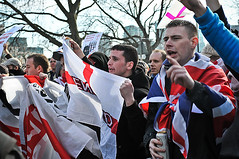
EDL march in support of Geert Wilders 05.03.10Image by belkus via Flickr


Anders Breivik, the alleged perpetrator of Norway's first domestic terror attack and worst act of violence since the second world war, is being widely described across the media as a "Christian fundamentalist" and a "conservative". Initial speculation by The Sun newspaper, the Daily Mail and CBS that the terror attacks were the work of al-Qaeda affiliates was it seems (not for the first time) a premature conclusion.

As a committed Christian myself, it is always distressing to hear the word "Christian" and "terrorism" appearing in the same sentence. I imagine the vast majority of Muslims can relate to that feeling.

So painful is it to consider the possibility that a professed follower of Christ could willfully arm himself with firearms and fertilizer bombs and, in a calculating fashion deliberately murder scores of innocent people, that it is understandable why some fellow-Christians will instinctively respond to recent events by saying, "He was not a real Christian." Indeed, many people who are not Christians would tend to instinctively come to the same conclusion. 

Such a knee-jerk reaction is understandable. Rightly so, we want to draw a sharp distinction between the murdering fanatic and the peaceable majority, who overwhelmingly reject and abhor the acts of destruction carried out by an apparently lone individual in the name of extremist politicised religion.

Rise of "Christian" Nationalism

Beyond these attempts at distancing themselves from the terrorists, however, European Christians have been reminded through Breivik's outrage of the theological and political challenge, perhaps hitherto ignored, of the rise of the heresy of extreme "Christian" nationalism.

Although there are parallels between this pan-European movement and similar white supremacist movements in the United States (epitomised by the Ku Klux Klan), the roots and manifestation of these two strands are sufficiently distinct to warrant separate investigation. For the purpose of this article, I will focus on the European dimension to the rise in the heresy of ultra-right "Christian" nationalism.


Anders Breivik himself states (in the file-sharing site document.no, to which he has been a regular contributor): 

"I myself am a Protestant and baptized/confirmed to me by my own free will when I was 15. But today's Protestant church is a joke. Priests in jeans who march for Palestine and churches that look like minimalist shopping centres.... The only thing that can save the Protestant church is to go back to basics." 

Andres Breivik's call for church reform illustrates the insidious nature of this heresy: like all false teachings, it clothes itself in language and themes that will resonate with some in the mainstream churches who would never endorse the actions of Norway's worst mass murderer. Like all heretics, the false prophet Anders Breivik espouses a doctrine which contains some common ground with large swathes of mainstream Christian opinion.

This superficial similarity of one aspect of his ideology should not obscure the fact that the rest of his doctrine is completely at odds with the teaching of the Bible and with the mainstream of historic and modern Christian teaching and practice.

Right-Wing Critique

His views share common ground with others on the political right who are critical of multi-culturalism, large scale non-European immigration and what they see as a Marxist-based cultural critique of western history and institutions. Although not terrorists, these themes are discernible in the work of such conservative writers as Bruce Bawer, Melanie Phillips, Mark Steyn, Geert Wilders, Theodore Dalrymple, and Robert Spencer. Some include in their critique the specific idea that Muslims, multi-culturalists, supporters of the European Union and social democrats are part of a plot to undermine Europe’s Christian civilization.

Christians in this respect are at particular risk of being roped into this extremist narrative, in the same way that many within the German churches fell prey to Nazi ideology in the 1930s, or who at least failed to offer a robust theological and political critique of it. Christians should note with concern, for instance, the willingness of some on the far right to employ Christian themes, symbols and  narratives in their search for political influence. It is as bizarre as it disturbing that  the Church of England General Synod found it necessary in 2009 to explicitly ban membership of the BNP on the part of its clergy. 

Secretive

As an aside, it is worth noting that, like Hitler, whose "final solution to the Jewish question" was not central to his public policy at first, the Breivik brand of "Christian" nationalism does not make explicit (until now) the true nature of its doctrines of Nordic and Aryan racial purity which underpin its critique of multi-culturalism.

Elsewhere on Document.no, for instance, Breivik notes that he adheres to the Vienna School of thought on cultural conservatism - which he summarises as avoiding the advocacy of racist-based politics, but achieving the same outcome by emphasising that islamisation and multi-culturalism are themselves racist. In approaching public policy in this duplicitous manner,  Breivik demonstrates the traits of cult leaders through the centuries who have not been explicit and public about their doctrine, but who have only expressed their views openly once they have established power. 

In this vein, Breivik commends the tactics of Geert Wilders whose Party for Freedom emerged as the third-largest in the Dutch Parliament in last year's national elections. Breivik also commends joining the anti-islamic group Stop the Islamisation of Europe (SIOE) and is impressed by the tactics of the English Defence League who he says, have gained political ground by highlighting the alleged racist nature of multiculturalism rather than by espousing an explicit doctrine of white supremacy. Breivik states his three priorities for the conservative nationalist cause in Norway as being the creation of a conservative national newspaper, the control of non-governmental organisations in receipt of state funding and, finally, the establishment of a political party equivalent to the EDL.

The Idea of Christendom

European Christian Nationalism rests upon a toxic mix of beliefs and ideology. At its heart is the Roman Catholic, and later Protestant, idea of Christendom. This is the idea that a nation state, or an empire, can be "Christian". It includes the idea of an official state church (whether Roman Catholic as in the case of southern Europe, Lutheran as in much of Scandanavia, or Anglican as in the UK). The idea has its roots ultimately in the supposed conversion of the Emperor Constantine in the early fourth century and the Edict of Thessaloniki 70 years later which made Christianity not only legal, but the only permitted religion of the Empire.

The church's transition in less than a century from persecuted to persecutor is well expressed in the text of the Edict:
“According to the apostolic teaching and the doctrine of the Gospel, let us believe in the one deity of the Father, the Son and the Holy Spirit, in equal majesty and in a holy Trinity. We authorize the followers of this law to assume the title of Catholic Christians; but as for the others .... they will suffer in the first place the chastisement of the divine condemnation and in the second the punishment of our authority which in accordance with the will of Heaven we shall decide to inflict.”

Although the church and the state were understood as having separate functions within the life of the nation or empire, in practice, the presence of an "official" religion through the medieval and modern period in many western European countries has resulted in the creation of a mindset that equates the one with the other. Even today, in an increasingly secular continent, many millions of citizens will describe themselves by default as belonging to the official state-sanctioned church. To be British is still mistakenly seen by millions as to be Christian.

Confusion, Nominalism and Persecution

As well as contributing hugely to nominalism within the church, such a confusion between the nation state and the church has also historically had a devastating effect on the nations that adhere to it, as well as to their neighbours. The violent expulsion of England's small Jewish community during the reign of Edward I in 1290, for instance, was one of numerous acts of of anti-semitism carried out in the name of Christianity in medieval and modern Europe. The Crusades has a similar theological underpinning.

In the post 9-11 age, the resurgent idea of European Christendom has Islam rather than Judaism in its sights. To be "anti-immigration" in modern Europe is code for being "anti-Muslim immigration."


Brevik's conservative doctrines bear out this view. The manifesto 2083: a European Declaration of Independence was published online on the day of the attacks in Norway and is being claimed as the work of Breivik, written in English under the name Andrew Berwick.  Even if this proves not to be the case, its content is relevant to the discussion on the characteristics of Europe's right-wing extremists. The document is heavily focused on anti-Muslim rhetoric, with over 900 references in its pages, the vast majority pejorative.

Included in the Declaration's critique of multiculturalism, Marxism and Islam is a complaint about the rise of liberal approaches to the Bible in European universities, describing undergraduate courses such as "The Bible as Literature" as a "course designed to denigrate the Bible as cleverly crafted fiction instead of God's truth."

It is common for theologically conservative Christians to express similar concerns about the denigration of the Bible, a fact which  makes the Breivik/Berwick heresy particularly insidious, by mixing falsehood alongside truth in a seamless whole.

The Deception of Common Ground

This appearance of common ground between the extreme right and conservative elements within the churches can be reinforced by a narrative that portrays Christians as increasingly victims of secular policies and laws (such as those promoting gay rights) that are increasingly discriminatory to Christians. In such a charged environment, a simplistic narrative that links individual rulings at employment tribunals with a meta-narrative of a Muslim-Marxist-multi-cultural takeover of Europe are as insidious and harmful as they are appealing to some who are already pre-disposed to a conservative mindset.

As Simon Barrow of think tank Ekklesia notes, Christians must urgently respond to these trends by acknowledging, addressing and combating,

"the sometimes disturbing links in our midst between ideological 'Christianism' (as I think it deserves to be called), anti-foreigner nationalism, and the growth of a sometimes naive and sometimes malevolent 'Christianophobia' narrative. The latter can be seen emerging as talk of 'Christian persecution' within Britain. It is part of a fearful, defensive response to the growth of socio-cultural diversity in Western societies, and to the corresponding demise of a 'Christendom' culture that privileged one kind of civic religion."

The Alternative to Christendom
     
In his ground-breaking book The Reformers and Their Stepchildren , Leonard Verduin sets forth a very different approach to Christendom to that advocated by the new nationalists. The "stepchildren" of the sixteenth-century Reformation were the radical groups which not only held to a Protestant understanding of justification by faith, but who at the same time rejected the idea of a state church and of Christendom itself. In the understanding of these believers, the nation-state is, by definition, a religiously mixed entity. Although rulers throughout history have often found it expedient to adopt and promote an "official religion" held by all their subjects, Verduin shows how the radical reformers (anabaptists and independents) insisted that societies are religiously pluralistic. All they sought was the freedom to gather, preach and worship according to their consciences, without the support or the interference of state regulations, law courts or fines for the non-conformist.

The fact that many of these "third-stream" believers were themselves persecuted by both Catholic and Protestant church and secular rulers during the Reformation era highlights the essential difference between their understanding of the relationship between church and state and that of their Constantinian opponents. The model of the separation of church and state was to find its ultimate expression in the Constitution of the United States some 300 years later.

The German  Experience

More recently, the clarity and courage of the so-called "confessing church" of 1930s Germany provies another alternative to Christendom. Under the leadership of Karl Barth, Dietrich Bonhoeffer and Martin Niemoller the "confessors" separated from the official state-sanctioned Protestant church and protested its nazification of Christianity under the influence of Hitler's religious affairs minister Ludwig Muller. 

As Phil Wood notes:

"Christianity makes a poor civil religion.  Allegedly it 'enfeebled' a people.  The Nazis believed this, hence the attraction of Alfred Rosenburg's 'Positive Christianity'.  Rosenburg attempted to rid the Bible of its Jewish heritage and claimed the 'Aryanhood' of Christ.  His influence can still be traced in today's far-right groups, which espouse either outright paganism or a tractable and bastardized Christianity." 

European Protestants today should take a cautionary note of the fact that it was the writings of the much-admired German-born Martin Luther (particularly the 400th anniversary of his 95 thesis) that were used as a springboard by extremists to promote the "German Christian" (ie, Nazified) movement in the years following WWI.

Urgent Work

It is interesting to note that when Muslim-backed acts of terror take place, they are routinely described in the west as expressions of global jihad. When equally atrocious acts take place by non-Muslim white westerners, they are described as acts of deranged madmen. Such a convenient explanation  has been blown apart in the carnage of the Norway killings. Christians across Europe, not to mention the wider societies they belong to, need to wake up to the heresy that needs confronting. and embark more vigorously on that uncomfortable and urgent work. 


If you enjoyed this post, get free updates by email or RSS.
Enhanced by Zemanta

Thursday, November 18, 2010

The Politics of X factor

Just submitted an article to Telewatch on the links between X factor and the state of politics in the UK.

What do you think?


If you enjoyed this post, get free updates by email or RSS.

Thursday, October 14, 2010

Chilean Mine Rescue: Spreading the Love

Miner in a mine of the "Cerro Rico" ...Image via Wikipedia
Apart from the 33 rescued miners, a number of others seem to have benefited from yesterday's dramatic and heart-warming rescue from the Chilean mountains:

  • the world's media. It has been a relatively easy story to report on - with a permanent media centre on site, a stable physical environment, a predictable timetable of events and a wonderful human interest story (with inevitable spin offs into profiles of the miners and their families). Certainly an easier story to report on than, say, the war in Somalia. Having said that, it appears from a leaked email published on today's Guardian that the BBC have overspent on their Chile mine story - a situation which BBC World News editor Jon Williams describes as "serious".
  • the President of Chile. Sebastian Pinera has not been backward in coming forward, as the world's media have focused in on this good news story in his backyard. I even noticed one BBC report describing him as the "leader" of the rescue. I would be very surprised if that were an accurate description of his role, but the political capital that has rubbed off on the 61-year-old Harvard graduate has been considerable.
  • the popular psychology industry. Although I do not agree with everything Brendan O'Neill says on the subject (here), he does raise some important questions about the allegedly authoritarian role played by the 300-plus medical and psychology professionals who "supported" the miners from the top. In particular, claims that letters from family members were withheld from certain miners because of their potential to damage the psychology of individuals underground, are, if true, a cause for concern. Nonetheless, the world's media have predictably wheeled on their chosen experts to explain how the miners must have been feeling - thus reinforcing the power of such professionals and meeting a felt need for ever more intrusive public access into the very souls of those making the news.

My personal favourite anecdote from the mine story is of the t-shirts worn by the miners on their rescue. I'll let my friend Heidi Chase (Spanish speaker and oft-times South American resident) summarize from her facebook profile:

“Written on the back of the t-shirts the Chilean miners were wearing as they came to the surface…

“Porque en su mano están las profundidades de la tierra, Y las alturas de los montes son suyas”

(Because in His hand are the depths of the earth and the heights of the mountains are His) Psalm 95 V4”


If you enjoyed this post, get free updates by email or RSS.

Tuesday, September 28, 2010

UN Fact-Finding Mission Says Israelis "Executed" US Citizen Furkan Dogan

Seal of the United States Department of State.Image via Wikipedia
t r u t h o u t | UN Fact-Finding Mission Says Israelis "Executed" US Citizen Furkan Dogan

Far be it from me to wade into an analysis of the Israeli-Palestine issue - which, to quote President Obama, would be "above my pay grade" - but.....

The official UN report on the human rights aspect of the boarding of the flotilla to Gaza by Israeli commandos in May of this year has been published. In fact, it was published in July. No, I hadn't heard anything about it either.

Which is surprising, because an American citizen, Furkan Dogan was among those killed during the raid. The UN report on his death makes uncomfortable reading, describing his death as an "execution".

Gogan was shot twice in the head, once in the back and in the left leg and foot before being shot in the face at point blank range while lying on the ground. Based on the "forensic and firearm evidence," the UN panel concluded that Dogan's killing and that of five Turkish citizens, "can be characterized as extra-legal, arbitrary and summary executions."

My point in relating this unpleasant story is to highlight the way that, when pursuing their foreign policy objectives, elected governments such as that of the United States will often make use of the death of their citizens overseas as a way of justifying aggressive actions against the offending states.

On this occasion, however, the US administration is pursuing a policy of not commenting on the incident. In a written statement, which appears to have been dragged out of a reluctant State Department by Truthout magazine, we read:


"We urge that this report not be used for actions that could disrupt direct negotiations between Israel and Palestine that are now underway or actions that would make it not possible for Israel and Turkey to move beyond the recent strains in their traditional strong relationship."


There we have it then. And not a hint of the story being reported on the main US media channels.


If you enjoyed this post, get free updates by email or RSS.