Anders Breivik, the alleged perpetrator of Norway's first domestic terror attack and worst act of violence since the second world war, is being widely described across the media as a "Christian fundamentalist" and a "conservative". Initial speculation by The Sun newspaper, the
Daily Mail and CBS that the terror attacks were the work of al-Qaeda affiliates was it seems (not for the first time) a premature conclusion.
As a committed Christian myself, it is always distressing to hear the word "Christian" and "terrorism" appearing in the same sentence. I imagine the vast majority of Muslims can relate to that feeling.
So painful is it to consider the possibility that a professed follower of Christ could willfully arm himself with firearms and fertilizer bombs and, in a calculating fashion deliberately murder scores of innocent people, that it is understandable why some fellow-Christians will instinctively respond to recent events by saying, "He was not a real Christian." Indeed, many people who are not Christians would tend to instinctively come to the same conclusion.
Such a knee-jerk reaction is understandable. Rightly so, we want to draw a sharp distinction between the murdering fanatic and the peaceable majority, who overwhelmingly reject and abhor the acts of destruction carried out by an apparently lone individual in the name of extremist politicised religion.
Rise of "Christian" Nationalism
Beyond these attempts at distancing themselves from the terrorists, however, European Christians have been reminded through Breivik's outrage of the theological and political challenge, perhaps hitherto ignored, of the rise of the heresy of extreme "Christian" nationalism.
Although there are parallels between this pan-European movement and similar white supremacist movements in the United States (epitomised by the Ku Klux Klan), the roots and manifestation of these two strands are sufficiently distinct to warrant separate investigation. For the purpose of this article, I will focus on the European dimension to the rise in the heresy of ultra-right "Christian" nationalism.
Anders Breivik himself
states (in the file-sharing site document.no, to which he has been a regular contributor):
"I myself am a Protestant and baptized/confirmed to me by my own free will when I was 15. But today's Protestant church is a joke. Priests in jeans who march for Palestine and churches that look like minimalist shopping centres.... The only thing that can save the Protestant church is to go back to basics."
Andres Breivik's call for church reform illustrates the insidious nature of this heresy: like all false teachings, it clothes itself in language and themes that will resonate with some in the mainstream churches who would never endorse the actions of Norway's worst mass murderer. Like all heretics, the false prophet Anders Breivik espouses a doctrine which contains some common ground with large swathes of mainstream Christian opinion.
This superficial similarity of one aspect of his ideology should not obscure the fact that the rest of his doctrine is completely at odds with the teaching of the Bible and with the mainstream of historic and modern Christian teaching and practice.
Right-Wing Critique
His views share common ground with others on the political right who are critical of multi-culturalism, large scale non-European immigration and what they see as a Marxist-based cultural critique of western history and institutions. Although not terrorists, these themes are discernible in the work of such conservative writers as Bruce Bawer, Melanie Phillips, Mark Steyn, Geert Wilders, Theodore Dalrymple, and Robert Spencer. Some include in their critique the specific idea that Muslims, multi-culturalists, supporters of the European Union and social democrats are part of a plot to undermine Europe’s Christian civilization.
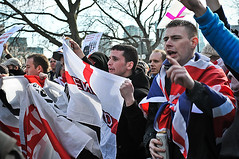
Christians in this respect are at particular risk of being roped into this extremist narrative, in the same way that many within the German churches fell prey to Nazi ideology in the 1930s, or who at least failed to offer a robust theological and political critique of it. Christians should note with concern, for instance, the willingness of some on the far right to employ Christian themes, symbols and narratives in their search for political influence. It is as bizarre as it disturbing that the Church of England General Synod found it necessary in 2009 to explicitly ban membership of the BNP on the part of its clergy.
Secretive
As an aside, it is worth noting that, like Hitler, whose "final solution to the Jewish question" was not central to his public policy at first, the Breivik brand of "Christian" nationalism does not make explicit (until now) the true nature of its doctrines of Nordic and Aryan racial purity which underpin its critique of multi-culturalism.
Elsewhere on Document.no, for instance, Breivik notes that he adheres to the Vienna School of thought on cultural conservatism - which he summarises as avoiding the advocacy of racist-based politics, but achieving the same outcome by emphasising that islamisation and multi-culturalism are themselves racist. In approaching public policy in this duplicitous manner, Breivik demonstrates the traits of cult leaders through the centuries who have not been explicit and public about their doctrine, but who have only expressed their views openly once they have established power.
In this vein, Breivik commends the tactics of Geert Wilders whose Party for Freedom emerged as the third-largest in the Dutch Parliament in last year's national elections. Breivik also commends joining the anti-islamic group Stop the Islamisation of Europe (SIOE) and is impressed by the tactics of the English Defence League who he says, have gained political ground by highlighting the alleged racist nature of multiculturalism rather than by espousing an explicit doctrine of white supremacy. Breivik states his three priorities for the conservative nationalist cause in Norway as being the creation of a conservative national newspaper, the control of non-governmental organisations in receipt of state funding and, finally, the establishment of a political party equivalent to the EDL.
The Idea of Christendom
European Christian Nationalism rests upon a toxic mix of beliefs and ideology. At its heart is the Roman Catholic, and later Protestant, idea of Christendom. This is the idea that a nation state, or an empire, can be "Christian". It includes the idea of an official state church (whether Roman Catholic as in the case of southern Europe, Lutheran as in much of Scandanavia, or Anglican as in the UK). The idea has its roots ultimately in the supposed conversion of the Emperor Constantine in the early fourth century and the Edict of Thessaloniki 70 years later which made Christianity not only legal, but the only permitted religion of the Empire.
The church's transition in less than a century from persecuted to persecutor is well expressed in the text of the Edict:
“According to the apostolic teaching and the doctrine of the Gospel, let us believe in the one deity of the Father, the Son and the Holy Spirit, in equal majesty and in a holy Trinity. We authorize the followers of this law to assume the title of Catholic Christians; but as for the others .... they will suffer in the first place the chastisement of the divine condemnation and in the second the punishment of our authority which in accordance with the will of Heaven we shall decide to inflict.”
Although the church and the state were understood as having separate functions within the life of the nation or empire, in practice, the presence of an "official" religion through the medieval and modern period in many western European countries has resulted in the creation of a mindset that equates the one with the other. Even today, in an increasingly secular continent, many millions of citizens will describe themselves by default as belonging to the official state-sanctioned church. To be British is still mistakenly seen by millions as to be Christian.
Confusion, Nominalism and Persecution
As well as contributing hugely to nominalism within the church, such a confusion between the nation state and the church has also historically had a devastating effect on the nations that adhere to it, as well as to their neighbours. The violent expulsion of England's small Jewish community during the reign of Edward I in 1290, for instance, was one of numerous acts of of anti-semitism carried out in the name of Christianity in medieval and modern Europe. The Crusades has a similar theological underpinning.
In the post 9-11 age, the resurgent idea of European Christendom has Islam rather than Judaism in its sights. To be "anti-immigration" in modern Europe is code for being "anti-Muslim immigration."
Brevik's conservative doctrines bear out this view. The manifesto
2083: a European Declaration of Independence was published online on the day of the attacks in Norway and is being claimed as the work of Breivik, written in English under the name Andrew Berwick. Even if this proves not to be the case, its content is relevant to the discussion on the characteristics of Europe's right-wing extremists. The document is heavily focused on anti-Muslim rhetoric, with over 900 references in its pages, the vast majority pejorative.
Included in the Declaration's critique of multiculturalism, Marxism and Islam is a complaint about the rise of liberal approaches to the Bible in European universities, describing undergraduate courses such as "The Bible as Literature" as a "course designed to denigrate the Bible as cleverly crafted fiction instead of God's truth."
It is common for theologically conservative Christians to express similar concerns about the denigration of the Bible, a fact which makes the Breivik/Berwick heresy particularly insidious, by mixing falsehood alongside truth in a seamless whole.
The Deception of Common Ground
This appearance of common ground between the extreme right and conservative elements within the churches can be reinforced by a narrative that portrays Christians as increasingly victims of secular policies and laws (such as those promoting gay rights) that are increasingly discriminatory to Christians. In such a charged environment, a simplistic narrative that links individual rulings at employment tribunals with a meta-narrative of a Muslim-Marxist-multi-cultural takeover of Europe are as insidious and harmful as they are appealing to some who are already pre-disposed to a conservative mindset.
As Simon Barrow of think tank Ekklesia
notes, Christians must urgently respond to these trends by acknowledging, addressing and combating,
"the sometimes disturbing links in our midst between ideological 'Christianism' (as I think it deserves to be called), anti-foreigner nationalism, and the growth of a sometimes naive and sometimes malevolent 'Christianophobia' narrative. The latter can be seen emerging as talk of 'Christian persecution' within Britain. It is part of a fearful, defensive response to the growth of socio-cultural diversity in Western societies, and to the corresponding demise of a 'Christendom' culture that privileged one kind of civic religion."
The Alternative to Christendom
In his ground-breaking book
The Reformers and Their Stepchildren
, Leonard Verduin sets forth a very different approach to Christendom to that advocated by the new nationalists. The "stepchildren" of the sixteenth-century Reformation were the radical groups which not only held to a Protestant understanding of justification by faith, but who at the same time rejected the idea of a state church and of Christendom itself. In the understanding of these believers, the nation-state is, by definition, a religiously mixed entity. Although rulers throughout history have often found it expedient to adopt and promote an "official religion" held by all their subjects, Verduin shows how the radical reformers (anabaptists and independents) insisted that societies are religiously pluralistic. All they sought was the freedom to gather, preach and worship according to their consciences, without the support or the interference of state regulations, law courts or fines for the non-conformist.
The fact that many of these "third-stream" believers were themselves persecuted by both Catholic and Protestant church and secular rulers during the Reformation era highlights the essential difference between their understanding of the relationship between church and state and that of their Constantinian opponents. The model of the separation of church and state was to find its ultimate expression in the Constitution of the United States some 300 years later.
The German Experience
More recently, the clarity and courage of the so-called "confessing church" of 1930s Germany provies another alternative to Christendom. Under the leadership of Karl Barth, Dietrich Bonhoeffer and Martin Niemoller the "confessors" separated from the official state-sanctioned Protestant church and protested its nazification of Christianity under the influence of Hitler's religious affairs minister Ludwig Muller.
"Christianity makes a poor civil religion. Allegedly it 'enfeebled' a people. The Nazis believed this, hence the attraction of Alfred Rosenburg's 'Positive Christianity'. Rosenburg attempted to rid the Bible of its Jewish heritage and claimed the 'Aryanhood' of Christ. His influence can still be traced in today's far-right groups, which espouse either outright paganism or a tractable and bastardized Christianity."
European Protestants today should take a cautionary note of the fact that it was the writings of the much-admired German-born Martin Luther (particularly the 400th anniversary of his 95 thesis) that were used as a springboard by extremists to promote the "German Christian" (ie, Nazified) movement in the years following WWI.
Urgent Work
It is interesting to note that when Muslim-backed acts of terror take place, they are routinely described in the west as expressions of global jihad. When equally atrocious acts take place by non-Muslim white westerners, they are described as acts of deranged madmen. Such a convenient explanation has been blown apart in the carnage of the Norway killings. Christians across Europe, not to mention the wider societies they belong to, need to wake up to the heresy that needs confronting. and embark more vigorously on that uncomfortable and urgent work.
If you enjoyed this post, get
free updates by email or RSS.